Dear friends,
Is pride a virtue or a vice? Is it right or even wise to boast of oneself? Traditionally, modesty has long been commended and pride decried. But today, we encourage the young to be proud of themselves, and we hear celebrities of all kinds proclaiming pride in themselves and their achievements. What place, then, does pride have in the Christian life? Should we be proud to be Christians?
The ancient world, as with the modern, places great emphasis on learning, education and wisdom. The human ability to think deeply is one of the great distinctive characteristics of our species. But does God set limits on human wisdom? Can we judge God or even know him by our wisdom?
The gospel always undermines human pride in ways we never expect, and so I hope you enjoy our discussion in this episode. Thank you to those who have inspired conversations by contacting us and providing feedback; if you want to do the same, please write to us at respond@twm.email.
Yours,
Phillip
Peter Jensen: Continuing in our series on 1 Corinthians, we are now moving into the body of chapter 1, starting at verse 18. In the preceding verses, as we discussed last time, Paul talks about the divisions in the church. He concludes his point by mentioning that while he did baptise some people, he says, verse 17, “For Christ did not send me to baptise but to preach the gospel, and not with words of eloquent wisdom, lest the cross of Christ be emptied of its power.” If you asked a class at a theological college to finish the sentence in verse 17, assuming they’d never read it before, I doubt that they would finish it with these words, “lest the cross of Christ be emptied of its power.” It is astonishing, because we often don’t see how central the cross is, nor the way it speaks of the power of God. We think about God in terms of miracles and of healings, but the cross exhibits the power of God in an extraordinary way.
Phillip Jensen: What we have in that passage is a contrast, not simply between baptism and preaching, but between eloquent words and the power of the cross.
Peter: In fact, the gospel preached by Christ and by Paul was ridiculous to the world. Any modern advertiser would strongly discourage their client from selling their product in the way that the Apostle Paul was preaching the gospel. In our day and age, we don’t realise how incredibly absurd the Christian message was in the 1st century, firstly because it was about the Jewish God. Although some Gentiles were understandably drawn to the Jews, they were a minority, and they were looked upon as strange. The Jewish religion was so unusual in the pagan world that it was regarded as something ridiculous, and thus the gospel was profoundly disregarded.
Phillip: Even within the Jewish framework, the idea of a crucified Christ is nonsensical. It’s hard for us to imagine now how unbelievable it was to proclaim that your god was crucified. Within the scriptures, it is said that anyone who hangs from a tree is under the curse of God.
Secondly, from the Roman point of view, someone who was crucified was a failure of a person. One of the oldest pieces of graffiti in Rome, dating back to around 200 AD, depicts a man named ‘Alexaminos’ worshipping a crucified man with a donkey’s head. This piece of graffiti was making fun of the idea that someone’s god would be crucified. It was a particularly absurd idea because crucifixion was not only cruel, but it was the most degrading, shameful way of being executed. No Roman citizen was ever supposed to be crucified; it was what happened to slaves, to foreigners, and to rebels. So this gospel about the crucifixion was nonsense to the Jews and to the Romans.
Peter: These days, if we were the apostles, we would probably agree to tell people what Jesus said, and of the miracles he performed, but to never talk about his disastrous end.
Phillip: Indeed, we would want to focus on how Jesus can satisfy and give meaning to your life. There’s a whole range of things Jesus can do for you which, from a public relations point of view, are much more interesting and attractive than his crucifixion.
Peter: Funnily enough, that sounds a bit like some modern preaching that we hear.
Phillip: Yes, it’s the idea that we must emphasise the positive rather than the negative: that we should not mention sin, judgement, or Jesus’ crucifixion.
Peter: That’s right. But not only was the idea of God being crucified unbelievable; the resurrection was equally abhorrent and absurd. Before the invention of modern medicine, your body was your enemy. The length of life was much shorter than it is today. The pain and suffering that people put up with is now unimaginable. Today, a problem like a rotten tooth can be resolved within 24 hours, but back then, it could cause lifelong problems. If you did have an operation of some sort, there would be no kind of pain relief. The body was, then, something that you wanted to get rid of.
Phillip: There was also a philosophical aspect to the relationship between a person and their body.
Peter: Upon death, the spirit was believed to leave the body. Within that framework, if you were crucified, the spirit that left the body would be attached still to the earth. You could not ascend to the heavens, even if you were crucified as an innocent. If we were sitting with the apostles, discussing the most convincing way to preach the gospel into the world, we would say, “Let’s talk about what Jesus said, and the miracles he performed. But we should avoid the resurrection, and the idea inherent in the resurrection that every human being would be resurrected.”
Phillip: What is the connection between Jesus’ resurrection and the promise of everybody being resurrected?
Peter: It’s eschatology again: that is, the study of what the Bible teaches about the end of all things. For what Daniel 12 teaches us is that there will be a moment when everyone who is in the dust of the earth will rise, and God will create a new heaven and a new earth. He will revise all things and set us in this new world. But when we get to 1 Corinthians 15, we will discover how the body is utterly transformed and suitable for the new world. But here, we have the resurrection of all human beings: both those who believe and those who don’t — though the fate of each is going to be different.
Phillip: This was where the Pharisees and the Sadducees disagreed. For what they disagreed about was this eschatological resurrection that you mentioned.
Peter: Indeed, and Jesus is the first fruit. The resurrection of Jesus is extraordinary. Theologically, it is the evidence that God has introduced the last days, because the first resurrection has occurred.
Phillip: When Paul preaches about that in Acts 17, the audience mocks him. They aren’t necessarily mocking Jesus’ resurrection, but the entire concept of a person being resurrected from the dead.
Peter: You wouldn’t want to preach this gospel in a million years. But we will now return to this idea of the cross and its connection to God’s revelation of himself.
Phillip: 1 Corinthians 1:19–21
For it is written, “I will destroy the wisdom of the wise, and the discernment of the discerning I will thwart.” Where is the one who is wise? Where is the scribe? Where is the debater of this age? Has not God made foolish the wisdom of the world? For since, in the wisdom of God, the world did not know God through wisdom, it pleased God through the folly of what we preach to save those who believe.
The desire of people is to decide for themselves who God is, by human reason or by seeing some mighty works. But the gospel is a revelation from God. ‘Revelation’ is a fascinating word, for Christians use it in a way that the non-Christian world doesn’t always understand. The word ‘revelation’ means ‘uncovering’, or a ‘disclosure’ of something. Revelation in this context is not the result of human searching or inquiring, but the result of God showing us who he is through the cross and the resurrection.
Peter: But in the Old Testament, we’re told that the creation is a revelation of God. Psalm 19 says, “The heavens declare the glory of God.” What is the connection between the cross and God’s revelation?
Phillip: While the heavens made clear the glory of God, people do not hear or see. For God has revealed himself by what he has created, but because of our evil, we suppress the truth of God’s revelation in creation. It’s the sinfulness of us humans that prevents us from seeing the truth. There’s no lack of evidence about God, but there is a lack of desire to know and to relate to God, because God rules over us. Obedience is not what we want; instead, we want to sit in judgement on God by human wisdom. That’s why we come to verse 19, “I will destroy the wisdom of the wise, and the discernment of the discerning I will thwart.” This verse quotes from Isaiah 29, which talks about the Assyrian siege of Jerusalem. At that point, the empire, having destroyed city after city, arrived at Jerusalem, intending to destroy it. But out of nowhere, they packed up and went home.
Why did they pack up and go home? Because God sent them home. God predicted it would happen, and it did. All the Israelites had to do was trust God, for he was going to do it. So all the wise prophecies and expectations from the Assyrians and the Jews were proven false, because God decided to thwart the wisdom of the wise. God has decided not to be known by wisdom; in fact, he uses his wisdom to thwart our wisdom. Clever people think they can understand everything, which is of course nonsense. You can learn certain things from empiricism, testing, surveys, and by rationalism, especially through mathematics. But you cannot learn what a person chooses to hide. The Enlightenment of the 18th century enthroned humans instead of God, and thus enthroned human reason instead of God’s wisdom. In the arrogance of the Enlightenment, we decided that God is answerable to humans. But God’s choice is to reveal himself to whomever he chooses to. It’s the same as ours in that regard. For example, we once had an older brother named Ralph. You will never know what he was like, unless you knew him personally or unless we revealed to you what Ralph was like. Personal knowledge requires not empiricism or rationalism, but revelation.
Peter: This means that the way into the knowledge of God is humility. It’s the willingness to listen and to hear. It is not the way of pride and boastfulness. Calvin begins his great work Institutes of the Christian Religion by putting the knowledge of God at the very center of things, and by asserting that there is a connection between the knowledge of God and the knowledge of ourselves. He says that the knowledge of ourselves has to be the knowledge that we have nothing, we are nothing, and we are sinful people. Our only way of knowing God is through God’s revelation of himself.
If we could come up with some philosophical proof of God’s existence, we could award ourselves medals. But that doesn’t actually relate you to God. It doesn’t mean that God is God for you because you have proved his existence. On the contrary, your pride may exempt you from that. It’s not that God and the gospel lack wisdom or power.
Phillip: 1 Corinthians 1:22–25
For Jews demand signs and Greeks seek wisdom, but we preach Christ crucified, a stumbling block to Jews and folly to Gentiles, but to those who are called, both Jews and Greeks, Christ the power of God and the wisdom of God. For the foolishness of God is wiser than men, and the weakness of God is stronger than men.
Peter: This makes me think of the cross of Christ, once regarded as so abhorrent that it was unmentionable in polite circles; now, the cross can be seen throughout the world. The cross has conquered the world. That is the power of God.
Phillip: It’s astonishing that the cross is the most recognised symbol in the world. It testifies to the fact that what was once completely powerless, a crucified man, is more powerful than anybody ever imagined. That which we think is foolish, a message about a man being crucified, is wiser than anything anybody ever imagined.
Peter: Let us return to this extraordinary point about the knowledge of God resting upon his revelation.
Phillip: But it’s not the universal revelation of God that we’re talking about here. It isn’t the creation revelation of God that all men see.
Peter: Let’s refer to the text to see whether you’re correct: in 1:24-25, Paul says
But to those who are called, both Jews and Greeks, Christ the power of God and the wisdom of God. For the foolishness of God is wiser than men, and the weakness of God is stronger than men.
Phillip: Those verses repeat Paul’s point in verse 18, “For the word of the cross is folly to those who are perishing, but to us who are being saved it is the power of God.”
Peter: Indeed, what we have read is so important, so heart wrenching. Our sin is so great that we cannot believe that we can receive this salvation.
According to some interpretations, when the gospel is preached, it is up to you to believe it. In a way, that’s true, but you must understand that when you do believe it, you only believe it because the light of the truth has shone in your heart, so that you may see the face of Jesus Christ. In other words, it’s God’s summons through his Holy Spirit that brings us to salvation. The reason that we tell you this is so that we cannot boast. As the hymn goes
Naked, come to thee for dress;
Helpless, look to thee for grace;
Foul, I to the fountain fly;
Wash me, Saviour, or I die.
The salvation we are talking about is entirely the work of God in its supreme achievement, its accomplishment, and its application to us. For we are called into the knowledge of God by the Holy Spirit.
Phillip: As Paul continues through verses 26–31
For consider your calling, brothers: not many of you were wise according to worldly standards, not many were powerful, not many were of noble birth. But God chose what is foolish in the world to shame the wise; God chose what is weak in the world to shame the strong; God chose what is low and despised in the world, even things that are not, to bring to nothing things that are, so that no human being might boast in the presence of God. And because of him you are in Christ Jesus, who became to us wisdom from God, righteousness and sanctification and redemption, so that, as it is written, “Let the one who boasts, boast in the Lord.”
Peter: Is there still a temptation for us to boast in our strength, as there was among the Corinthians?
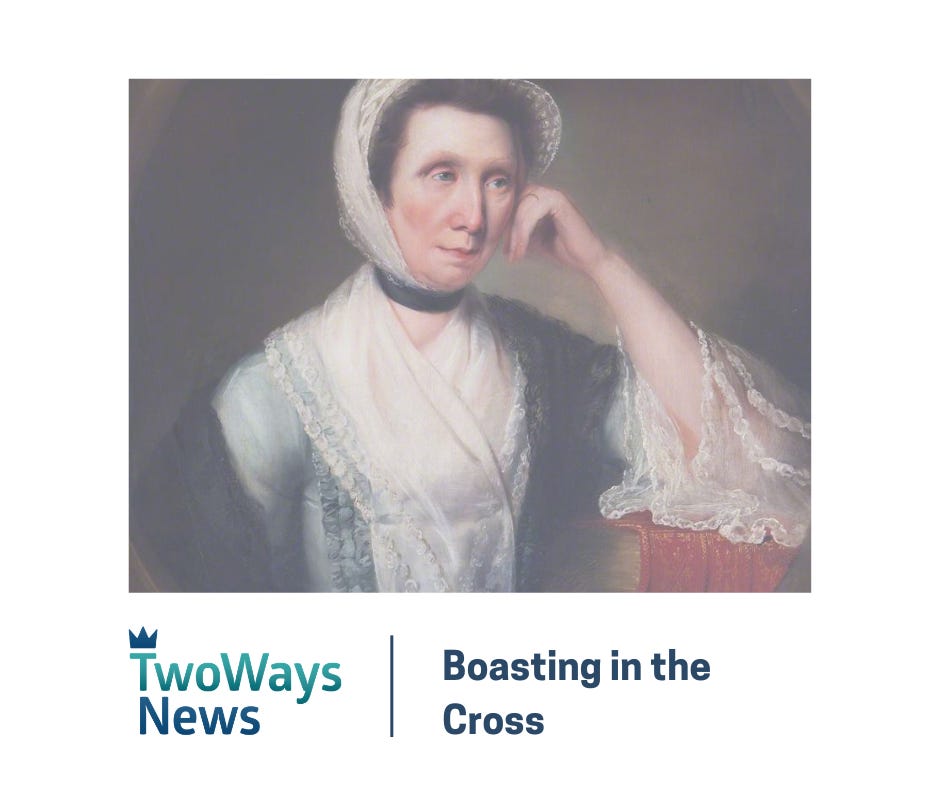
Phillip: Of course, there always is. In fact, it’s a modern practice to talk about being proud of oneself. Pride has now become a virtue in certain circles, but pride is never of the people of God. Our boast is in another: Christ Jesus. We are not significant in any shape, form or fashion of this world. The reality is that we’re unimpressive, we’re unimportant, and we’re weak. This is why the rich find it so hard to be saved, though it is possible. The Countess of Huntingdon, a famous and wealthy woman of the 18th century, said in regards to verse 26,
Blessed be God, it does not say “any mighty,” “any noble”; it says “many mighty,” “many noble.” I owe my salvation to the letter “m.” If it had been “not any noble,” where would the countess have been?
She knew that she was not saved because she was wealthy or significant or had the right family connections. She was saved because of the Lord Jesus Christ’s death. The death of Jesus empties us of all pride, of all self, as we simply cling to the cross. So it’s the basis of true piety that our boast is only in the Lord.
This affects so many things, such as evangelism. People often confuse apologetics, arguments, and philosophical debates with evangelism. However, the difference is that you don’t have to read up on all possible arguments to preach the gospel. In fact, it’s better that you simply tell people about the Lord Jesus Christ and his death for them.
People also confuse evangelism with miracles. Some speak of ‘power evangelism’, the performing of miracles to persuade people to turn to Christ. But it is the death of the Lord Jesus Christ which is the great power of God demonstrated in this world. This brings us back to the subject of divisions in the church. Because when I think I’m somebody, then I am tempted to fight with others; but when I recognise that without the Lord Jesus Christ, I am nobody, but with Christ, I am only one of the saved, that diminishes the fight, the pride, the quarrelling.
Peter: Boasting is not wrong; it’s what you boast in that can be right or wrong. You can boast about the achievements of your children, of your nation, of your own accomplishments, but that is all garbage. As this chapter concludes in verse 31, “As it is written, ‘Let the one who boasts, boast in the Lord.’”
We as Christians should not boast in our own achievements, our own righteousness, our own intelligence, or anything of that matter. Our boast is simply in the Lord because we are saved in him. To our readers, I ask the question: do you believe that? Is your boast only in the Lord Jesus, and what he has done for you in dying for you on the cross?
Scripture quotations are from The ESV® Bible (The Holy Bible, English Standard Version®), copyright © 2001 by Crossway, a publishing ministry of Good News Publishers. Used by permission. All rights reserved.
Links & Recommendations
For more on this topic, listen to this talk. It’s called The Foolishness and Weakness of God.
Freely available, supported by generosity.
If you enjoy Two Ways News, why not lend us a hand? Consider joining our Supporters Club—friends who make it possible for us to keep producing this article/podcast.
To join the Supporters Club, follow the link below to the ‘subscribe’ page. You’ll see that there’s:
a number of ‘paid options’. To join the Supporters Club take out one of the paid ‘subscription plans’ and know we are deeply grateful for your support!
also the free option (on the far right hand side)