Dear friends,
1 Corinthians 6 opens with a very challenging issue of disputes within the congregation. The Corinthians seem to have blown up these minor disputes into lawsuits against each other. This raises for us a plethora of issues about resolving disputes inside the church and when it is appropriate and right to take issues beyond the church into public law courts. I’m sure you will find this issue as complex as Peter and I discovered in our conversation.
Yours,
Phillip
Phillip Jensen: In this episode, we will be looking at the beginning of 1 Corinthians 6.
Peter Jensen: 1 Corinthians 6:1–8
When one of you has a grievance against another, does he dare go to law before the unrighteous instead of the saints? Or do you not know that the saints will judge the world? And if the world is to be judged by you, are you incompetent to try trivial cases? Do you not know that we are to judge angels? How much more, then, matters pertaining to this life! So if you have such cases, why do you lay them before those who have no standing in the church? I say this to your shame. Can it be that there is no one among you wise enough to settle a dispute between the brothers, but brother goes to law against brother, and that before unbelievers? To have lawsuits at all with one another is already a defeat for you. Why not rather suffer wrong? Why not rather be defrauded? But you yourselves wrong and defraud—even your own brothers!
This is a challenging passage. Once again, we are reminded the Corinthian church was far from perfect. The word ‘church’ to many people means ‘denomination’ – for example, the Anglican church or the Presbyterian church. But Paul is dealing here with disputes within the congregation, which is called ‘the church’. But what specific situation is Paul addressing?
Phillip: He’s not referring to the courts of the early Reformation period that just tried the clergy, but about grievances within the church. He speaks in terms of relatively trivial cases, such as disputes between brothers. Mind you, a dispute between brothers can entail being defrauded and suffering wrong, but generally speaking, it’s of small concern, and the matter can be settled by a wise person from within the ranks of the church. There’s the famous passage in Luke 12 where one man calls out to Jesus, “Teacher, tell my brother to divide the inheritance with me.” It’s an appeal for justice, yet Jesus tells him not to be greedy, then teaches the parable of the rich fool. Similarly, in Matthew 18:21, a man asks, “Lord, how often will my brother sin against me, and I forgive him? As many as seven times?” to which Jesus says, “I do not say to you seven times, but seventy-seven times.”
So why does the apostle regard taking things beyond the church as a shameful thing? Why is it so vital that we shouldn’t take things to court?
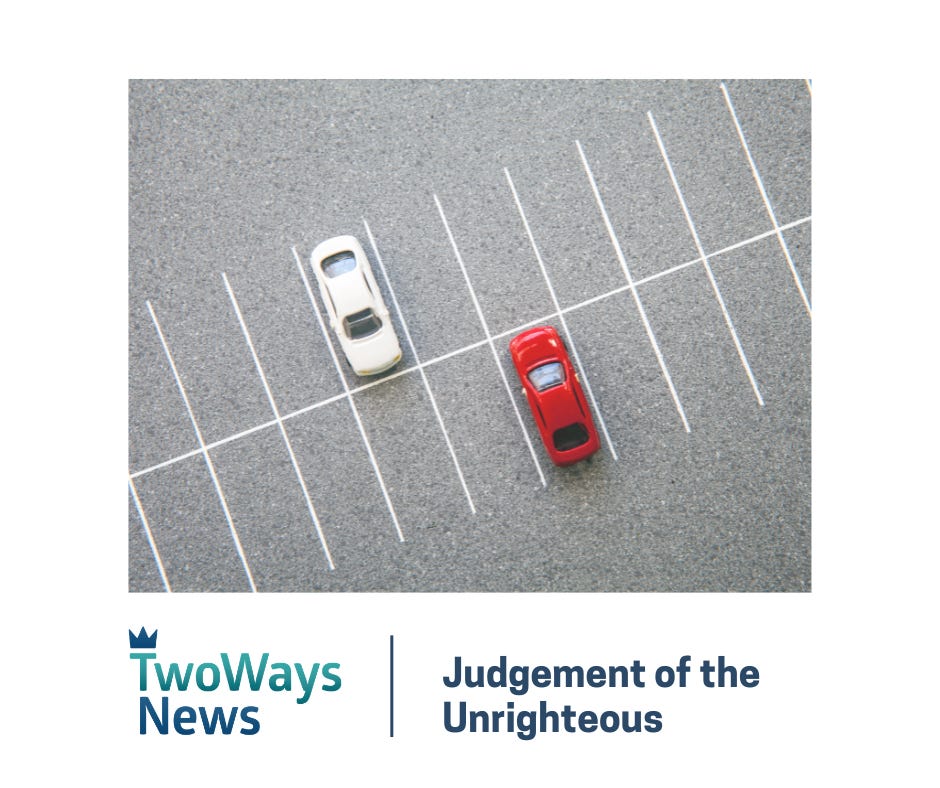
Peter: Before I come to that, I must add that sometimes these relatively trivial disputes within a congregation can be extraordinarily painful and can lead to bad results. We’re not saying they’re just trivial in the sense that they’re all minor matters about, for instance, where you park on a Sunday.
Phillip: But sometimes minor things are large because of our emotional reaction to them, when in fact they are very small. A parking spot can cause terrific fights.
Peter: That’s perfectly true. So the matter itself can be relatively trivial, but the emotions involved may not be. The apostle here mentions going to law before unbelievers, and he suggests that this is a shameful thing that brings the gospel into disrepute. You can imagine how this is true, especially in a village community where everybody knows everyone else. The matter becomes public, and in the wrong way. The fact of a dispute causing such passions as to be taken to court can do nothing good for the standing of the church. It says little for the wisdom of the saints that they can’t judge their own matters. If you’re a Christian, you have a clearer picture of what love, forgiveness and justice are, which ought to equip you to judge. But this raises some tricky issues that are very relevant to our own day in a way. What about criminal cases, for example? Has there been a tendency to deal with these within a denomination rather than taking them to the police or to the courts?
Phillip: Criminal cases should be reported and/or go before the governmental courts. But our problem is a little bit with this word ‘criminal’, because at the moment, the word is used with 2 different connotations. Technically, the word ‘criminal’ just means ‘against government legislation’. But government legislation can be immoral. Under our present government with its long Christian history, most of our governmental laws are of a Christian nature. But in a non-Christian society, we can have criminal behaviour which is godly, like preaching the gospel or praying publicly. But the word can also mean, ‘immoral’. In some situations, we may say something is criminal because it is immoral, even though it may not be against the law. However, if someone is doing something which is criminal because it is illegal and immoral, covering it up to guard the reputation of the ecclesiastical structure, rather than see the case dealt with, is a big mistake.
Our denominations have been doing this with the best intentions, but they absolutely should not be. God has given us government, as said in Romans 13, to deal with wrongdoing, and it’s to the government we should hand over matters of criminality. 1 Corinthians 6 says that in disputes between members of the congregation, we should be able to rule on those ourselves. But when you come to somebody committing a crime, we must take those matters to the courts to be dealt with properly. In recent decades, there have been many sexual abuse cases which have been covered up and not dealt with properly. What was done to the victims was wrong, and these cases should have been brought to court. Mind you, the church at this stage in the late 20th century was following the social norms of society. The police and the government generally underestimated the impact of sexual abuse upon children and did not deal with it properly. We’ve changed that attitude, and we need to continue doing so. But 1 Corinthians 6 simply deals with grievances between the saints.
But there are some matters that are tricky, like marriage breakdowns. Should divorce be settled between members of a congregation, or is that something to deal with externally?
Peter: This is a sensitive matter, because a number of our listeners will themselves have been through this or have witnessed it in their church. There’s every reason to think of a marriage breakdown pastorally, in the first instance, and to see whether the relationship can be restored. It’s a good thing if members of the congregation, particularly the pastor, can help to restore the relationship. This may involve recommending a counsellor, or the pastor may need to listen to both sides and offer biblical counsel on rights and wrongs. That is important, and it would fit in very much with this passage.
In a church I belonged to 50 years ago, there was a husband who was physically abusive to his wife. The chief pastor in the church rebuked the husband, advised the wife, and sought to bring peace and justice. In the end, the pastor advised the wife to consider leaving the husband because the man persisted in this abuse. He also gave up coming to church at the same time.
Phillip: But that crosses a line, because physical abuse is a crime that should be reported to the police.
Peter: It is nowadays, and it has become a crime because members of the public, households included, have not dealt with it very well. Sometimes, the person being abused may prefer it not to go to the courts, but the alternative would be that it goes on and the abuser is not brought to book as they should be.
Phillip: But it always was criminal. See, this is the trouble with this word ‘crime’. Physical abuse has always been a crime. We may not have recognised it as such as a society, but that was an error.
Peter: I agree with you. We have taken our freedoms and not used them well, which means that the law has to be far clearer and far more invasive on this issue. But sometimes there are decisions which flow from a breakdown, which may go well beyond the capacity of the saints to decide. There are decisions to be made about money, about property, and about who has the children. If these matters can be agreed to before the courts are involved, that would be good, provided the agreement is just. But it is a matter of secular law, for the marriage is registered by the state. So these issues may well need to go before the courts in order to be resolved in a way that can’t easily be resolved in a congregation.
Phillip: The law courts themselves are very big on trying to get people to discuss these matters before coming to court to settle them. The courts will reinforce the decisions that have been made in discussion with court appointed officers to come to some agreement. But within our society, there are people who are choosing not to get married, or there are people who are choosing religious marriages that are not part of secular registration. We know God doesn’t want divorce because divorce is always violent. It’s the breaking of a relationship of unity that God has created, and it damages children, grandparents, uncles, aunts and cousins. Our government in 1975 changed the divorce laws in such a way as to undermine marriage, for the covenant by which we take one as a spouse, has now been undermined. The words we say at a wedding service no longer mean what they mean, because you say, “For better, for worse, for richer, for poorer, until death do us part,” but you don’t mean that, legally speaking. The trouble is, God does unite us in marriage.
Last week, I saw in the paper that de facto marriages, which are growing in great numbers in Australia, are now being seen in exactly the same terms as de jure marriages. So when people think, “We won’t get married, so we can divide up 50-50 if we break up, and we can make our own decisions,” the courts do intervene. These marriages are then considered to be equally legitimate marriages, and you can lose your properties to your spouse as much as if you’d gone through the legal processes, because the legal marriage recognises a reality that children have rights. In a divorce, the property needs to be divided in ways that are concerned for the welfare of the children as well as for the people. So the sinfulness is not dealt with by just avoiding marriage law, for the law recognises the sinfulness of people. The reality is that we don’t always live together in harmony because we are sinful people.
As 1 Corinthians 7 tells us, if you cannot live with each other, then be separate. God does not want you to be separate, but if it is impossible to live together, then you should be separate, but not so you can marry a third party. The command is to live separately, and if you can’t stand being separate, then be reconciled. The Bible doesn’t encourage this mentality that I can change partners to solve my problems.
Peter: It would be good if such matters between members of the congregation could be resolved internally. Not criminal matters, but those of defamation, for instance.
Phillip: These are civil matters rather than criminal matters in terms of our courts. While you talk of the case many years ago where a marriage was lost and where violence was involved, over the many years I’ve seen quite a lot of marriages at the breaking point that have been restored, and some that have not. You can be reconciled on minor disputes or on more serious matters like the breakdown of a marriage through Christian intervention and pastoral care.
Peter: That’s a win. It’s one of the blessings of belonging to a church, ideally, that others around you can be on the front line of advice, help, counsel, and mediation.
Phillip: Absolutely. When it comes to owning property, though, that’s where the problem moves into another category, for you must work out who gets what.
Peter: It may be worked out within the fellowship before it goes to the court, but then it has to be agreed to by the court.
Phillip: Yes, because the property is licensed on the title deed, which is a government title deed.
But there are times when Christians and non-Christians within the legal system are at odds. The issue of women’s ordination in Australia during the 1990s demonstrated the problem we have with law now, because we are shifting to judicial activism from non-Christian lawyers and judges. They think that the settlement should be X, which is from a non-Christian point of view a just answer, but it is not just from a Christian point of view. In previous generations where we had Christian judges, or judges operating on a Christian basis, we were able to have confidence in the government to make just causes. But this is now becoming more difficult.
Peter: I think so. Think of the legal fights that we saw between, as I call them, the leavers and the stayers in the Episcopal Church in America. This was a big debate over sexual matters, during which around 100,000 people left the Episcopal Church and set up their own churches; still Anglican, but away from the Episcopal denomination, which in their view had fallen over the cliff theologically. That led to questions of who owned the property. Could the leavers not keep the property that they owned? In the end, the courts decided that the leavers could not keep the property, so it went to the original denomination. While this was very painful for all involved, I’m sorry that it was taken to court. Whether they stay or leave, they will be preaching the gospel, and it’s better for them to be able to do that, perhaps by renting the church, than for us to go to court and take the church from them. The implications need to be studied carefully, and we must always ask ourselves, “Why are we doing this?” We must also think about whether a Christian mediator could help, or even whether I should accept the wrong being done to me, as Paul suggests here in this very passage. Perhaps the idea of mediation is closer to what the passage is suggesting than simply taking things up with the law. There’s a difference in where things were back then and where things are now, but these, I think, are some of the direct implications of this passage.
Phillip: I have a problem though. That is, the passage is talking about minor things like you and I having a squabble over a parking spot. It’s not over whether the denomination or the congregation owns the property. While you may be able to settle that through Christian mediation or through mediation generally, in the end, the title deeds on a property is a decision of the government and of the courts.
Peter: It sounds to me as though this merits a bigger discussion.
Phillip: Absolutely. I’m just worried about pushing this passage beyond its scope in the discussion. But I’ve got another question. Paul says that the saints will judge the world and even angels, as 1 Corinthians 6:3 tells us, “Do you not know that we are to judge angels? How much more, then, matters pertaining to this life!”
Where in the Bible are we taught this other than in this passage? I thought Jesus was the judge of the living and the dead. Why are we then listed as judges? What is this business about the saints judging the world and judging angels?
Peter: If this verse was the only reference, I’d be a little bit agnostic about it. I guess I still am, but the reference that comes to mind is Matthew 19:27–28
Then Peter said in reply, “See, we have left everything and followed you. What then will we have?” Jesus said to them, “Truly, I say to you, in the new world, when the Son of Man will sit on his glorious throne, you who have followed me will also sit on twelve thrones, judging the twelve tribes of Israel.
There’s a picture of shared judgement. The way I see it, it is a marginal reference. There’s also Revelation 3:21, which is relevant. But it fits in with the fulfillment of our humanity in Jesus as image bearers. That’s who we are. We have trashed it, but not lost it. Image bearers are those who rule, those who govern the world; hence when the age to come is upon us, we will be still working for Christ. We’re told that too in 1 Corinthians 5:9. Christ, of course, is the last Adam, the man from heaven in whose image we are. Therefore, I take it that we will share something of his work, because he gives us work to do, seen here as judgement. But I think on the broader front, that’s a way of looking at it. Whether indeed we will be judging the world on the day of judgement, I can’t deny it, but I am not sure what it exactly means.
Phillip: Can it be that we are judges like in the Old Testament Book of Judges?
Peter: Yes, you wonder about that, don’t you? Because we think of judges with white wigs, but the judges in the Old Testament have a more active role in working out the righteousness of God.
Phillip: Yes, because they’re sitting on the thrones; they’re not sitting on the bench.
Peter: They’re sharing Christ’s rule under Christ’s lordship.
Phillip: Yes, and if you’re able to do that, then you should be able to help people sort out minor matters, like King Solomon did with the baby who was claimed by two women.
Scripture quotations are from The ESV® Bible (The Holy Bible, English Standard Version®), copyright © 2001 by Crossway, a publishing ministry of Good News Publishers. Used by permission. All rights reserved.
Links & Recommendations
For more on this topic, check out this talk. It’s called The Gospel and Lawsuits.
Freely available, supported by generosity.
If you enjoy Two Ways News, why not lend us a hand? Consider joining our Supporters Club—friends who make it possible for us to keep producing this article/podcast.
To join the Supporters Club, follow the link below to the ‘subscribe’ page. You’ll see that there’s:
a number of ‘paid options’. To join the Supporters Club take out one of the paid ‘subscription plans’ and know we are deeply grateful for your support!
also the free option (on the far right hand side)