Dear friends,
Peter took over our podcast today and uncharacteristically cross-examined me on my belief. The topic is very important: that is, the relationship between law and grace. But I was expecting the doctrine lecturer to take the lead now that we have left 1 Corinthians. I hope you enjoy the grilling I received. If you did, don’t forget to remind others to listen to our podcasts which are provided free of charge by the generosity of others.
Yours,
Phillip
Peter: Today, we are moving away from what we’ve been doing for the last months in looking at particular passages in the Bible. Don’t worry, we’re not moving away from the Bible altogether; we are beginning a series in which we look at issues and doctrines throughout it. This episode’s topic is on the biblical teaching on the law. I don’t mean the law of the land—though that’s not irrelevant—but biblical law.
So let’s start with the beginning of things. How did law emerge as such a significant thing in the Old Testament?
Phillip: God, in his wisdom and character of righteousness, conveyed law in the scriptures. You can think of his discussion with Abraham, and the knowledge of righteousness that Joseph had in knowing that adultery was wrong. But it really comes to fullness in the Old Testament when he rescues the people out of Egypt and calls them to be his people. To be his people, they need to live his way, so the ‘Constitution of Israel’, if you like, is laid out in the law when God met Israel at Mount Sinai. He spells it out initially in the Ten Commandments, the prolegomena of the law; then he gives the details of the law, spelling out how they’re to be living as his people, particularly when they get into the Promised Land.
Peter: Salvation first? It’s a bit like creation: the world is created, then Adam comes, then the law is given. The Lord speaks and sets out the boundaries of what it is to be human.
Do you have any thoughts about why the first 5 books of the Bible are called ‘The Law?’
Phillip: We have a limited usage of the word ‘law’ in modern English. We think of the law just in terms of legislation passed in through Parliament. But there’s also, for instance, the laws of physics. The word has had a wider usage in previous generations, and you still get the overtone of that sometimes. The Torah—the first 5 books—reveals God and his ways to you in the events that he supervised and in the failure of people to live his way.
Peter: Yes, and so the law we’re given, being the Commandments, is given in this broader context of events, not least in the context of creation and salvation.
Phillip: Yes, and especially in the context of salvation. God first states that he is the Lord, Yahweh, who has rescued the Israelites out of Egypt. Then he commands, Exodus 20:3, “You shall have no other gods before me.” He has rescued them out of Egypt, they have been invited to be his people, and they have sworn that they would be his people in Exodus 19. So he lays out the details of the law for them.
But it’s not just for the Israelites. Deuteronomy 4 states that when the nations of the world see the way they live, then they will know that there is a righteous God. So while the law is for Israel, it has importance for the other nations too.
Peter: Nowadays for us, and for Western civilisation generally, the Ten Commandments are very significant. They used to be on the walls of churches. But when you look at Deuteronomy or Exodus, the Commandments themselves are surrounded by clarifications about how the law applies to specific cases. For example, what happens if someone breaks into your house at night? Are you permitted to kill them? If the break-in happens at night, the answer is ‘yes’, but if it was during the day, ‘no’. That seems strange to us, but we live in the world of electric light. I’m presuming that if someone breaks in at night when there’s no light, then the law of self-defence comes in. But during the day, you can tell whether a person is simply there to nick a few things or whether they’re there to murder you. In that case, self-defence is permitted. This is interestingly close to the law of the land here: that self-defence is justified if you are in fear of your life, but not just because someone is trespassing. But tell me, what’s the shape of the law we’re given? It’s not just the Ten Commandments.
Phillip: The Ten Commandments simply tell us, “You shall not.” You are told what God will do to you if you break one of the Commandments: his jealousy will rise against you for the third and fourth generation. But the shape of it is love. The great theme of the law that Jesus summarises is this: love God and love your neighbour.
Notice that the early Commandments are about loving God. You shall have no other God but him; you must have no idols; honour his name. The later Commandments pertain to loving your neighbour: do not kill; do not steal. I think that the Commandment about the Sabbath pertains to both loving God and loving your neighbour. It’s also the trickiest of all those Commandments.
Peter: When Jesus tells us to love God and love your neighbour, he is simply quoting the Old Testament. It’s not a new thought.
Phillip: That’s right. Then there’s this other principle of “If this, then that,” which I believe forms the basis of case law. One of the beauties of our Australian legal system is this idea of case law: that as you come to different individual moments within the diversities of life, the judges and the courts are called upon to adjudicate what would be the fair, right, and just solution, which then creates the precedent upon which you can argue the next time a case comes. Life’s complexities are far too great to be able to just have a series of government-established decrees. I believe the Old Testament does that. But the laws given in Exodus and so on give you certain principles. For instance, Deuteronomy 25:4 commands, “You shall not muzzle an ox when it is treading out the grain.” This expresses the great principle that the labourer is worthy of his hire. God does it with the ox; how much more is it meant with the human?
So we are given a principle, and we are to meditate on it. We have to work to see what principle lies behind the particulars of the law, which has its application for a variety of cases that come before the courts.
Peter: So I guess then you shall not kill, but you are permitted to kill in certain circumstances.
Phillip: Yes. In fact, they’re directed to kill in circumstances such as war, or with lawbreakers.
Peter: Or someone breaking in at night.
Phillip: Yes, and they make distinctions within the law between murder and manslaughter, which we have today.
Peter: So why does God say that you shall not kill?
Phillip: Because there is an absolute, fundamental, knee-jerk reaction to murder. Killing always has to be justified. “We should not kill” is God’s basic command.
Peter: So we have the statute law, so to speak, of the Commandments. But what should I do if, say, my ox were to fall into a ditch on the Sabbath?
Phillip: That’s an easy question to answer, because the solution is in the text. You should dig the ox out of the ditch on the Sabbath because the life of the animal is more important than your preservation of rest on that day. In fact, you’re to give rest to your animals, and the cow in the ditch is not at rest.
Peter: So you can break the law in order to keep the law?
Phillip: Yes, but in doing so you are keeping the law.
Peter: I presume that’s the law of love. So you need the law, the Commandments, and love—all 3 of those things must work together. But what if I’m in a situation where 2 of those things conflict? In 1 Samuel 21, David and his men were starving to death. There was food available, but it was in the temple. David was not a priest, and so he was forbidden from touching the food of the temple—but he went and received it anyway. In Matthew 12, Jesus referenced this and said that it was the right thing for David to do.
Phillip: That was an extraordinary situation. But then David was an extraordinary person in the history of Israel.
Peter: That is true, but David was keeping the law still by determining that under these circumstances, the law of love dictates what you must do. Is that a fair way of putting it?
Phillip: You’re not told that in the New Testament use of that illustration. You’re on safer ground talking about the cow in the ditch.
There is the issue of determining that love wipes out what the law says. The other issue is that you can then pretend to keep the law by redefining the wording. With the situation of the cow in the ditch, you can, for example, call your farm ‘The Ditch.’
Peter: Yes. But the Lord knows the heart. So it’s no good being legalistic and saying, “This is a necessary moment for me to break the law.”
Phillip: One essay written by G.K. Chesterton expresses this point very well. He points to a situation in which a woman was told that in the rented accommodation she was in, she was not allowed to own a dog or a cat, but she was allowed to own a bird. So she went out and bought an ostrich.
Peter: You can’t beat G.K. Chesterton.
Phillip: Indeed. But you also can’t be the person who wants to avoid the law. The law is an ass at that point.
Peter: Yes, because the law cannot in itself defeat sin.
Phillip: It can’t govern the heart.
Peter: Indeed, and we’ll come back to that. But before we get there, the 39 Articles of Religion talk about the law of the Old Testament as being moral, ceremonial, and civil. The moral law has to be kept, while the ceremonial law is fulfilled in and through Jesus, the great high priest. His sacrifice takes the place of all the animal sacrifices and so forth. At any rate, do you remain happy with that distinction from the 16th century?
Phillip: I think that broadly it is a very useful analysis of the diversity of the law, but it is also an oversimplification. There are civil laws which are expressions of moral laws, like the cow in the ditch. There is a moral law lying behind that which we would call at this point a civil law, because it’s not one of the ceremonial laws, and it’s not put forward as the great moral law like the Ten Commandments. It’s more complicated than that three-pile division. But on the other hand, it is a very useful distinction.
Peter: Yes, and civil law reminds us that Israel was a theocracy, ruled by God. Australia is not a theocracy, but a democracy. The civil law of the Old Testament was for a particular time and space of their nationhood, but it can still speak to us today.
Phillip: Yes, there are certain elements of it which we don’t live by today. For instance, we do not put false prophets to death, and we shouldn’t be doing that as a civil, non-theocratic state.
Peter: I have one last question before we move from the Old Testament. Psalm 119 speaks about things like loving the law. Do you love the law?
Phillip: Yes. And we should love the law. You mentioned Psalm 119, but I think of Psalm 19:7–11
The law of the LORD is perfect,
reviving the soul;
the testimony of the LORD is sure,
making wise the simple;
the precepts of the LORD are right,
rejoicing the heart;
the commandment of the LORD is pure,
enlightening the eyes;
the fear of the LORD is clean,
enduring forever;
the rules of the LORD are true,
and righteous altogether.
More to be desired are they than gold,
even much fine gold;
sweeter also than honey
and drippings of the honeycomb.
Moreover, by them is your servant warned;
in keeping them there is great reward.
The Psalmist clearly has that love of the Lord, and I see no reason why the Christian shouldn’t have the same love of God’s very Word to us.
Peter: Indeed. What is the attitude of Jesus to the law? Does he repeal it?
Phillip: Jesus says in the Sermon on the Mount, Matthew 5:16–17
In the same way, let your light shine before others, so that they may see your good works and give glory to your Father who is in heaven.
Do not think that I have come to abolish the Law or the Prophets; I have not come to abolish them but to fulfil them.
We need to unpack what it means to “fulfil them,” but certainly Jesus upholds the law. He goes on to say, Matthew 5:19–20
Therefore whoever relaxes one of the least of these Commandments and teaches others to do the same will be called least in the kingdom of heaven, but whoever does them and teaches them will be called great in the kingdom of heaven. For I tell you, unless your righteousness exceeds that of the scribes and Pharisees, you will never enter the kingdom of heaven.
So Jesus upholding the law in that paragraph, which is so central to the Sermon on the Mount, gives us no reason to set aside the law because he’s come. You mentioned earlier that the ceremonial law has been fulfilled in Jesus, but that’s not because Jesus has said, “We don’t need temples, priests, or sacrifices.” It’s because Jesus is the temple, the priest, and the sacrifice, so we keep the ceremonial law through Jesus.
Peter: I agree with that, but doesn’t Jesus add to the law in Matthew 5?
Phillip: No. Though in other parts of the gospels, he calls upon people to deny themselves, take up the cross, and follow him, and I don’t find that quite in the Old Testament—at least, not expressed like that. But he’s not adding to the law; he’s explaining and expounding it. In fact, the Sermon on the Mount starts off discussing the righteousness of the law, and then in Matthew 7, the sermon comes to an end where he talks about the law and the prophets. So most of the sermon is about the law and the prophets, and Jesus fulfilling it. The key fulfilment he has in Matthew 5 is not in adding to the law, but showing what the law itself means.
Peter: It raises another issue: he constantly criticises the very ones who are doing their utmost to keep the law. The word ‘Pharisee’ to us is a very nasty word, but back then, the Pharisees were widely admired in the community as those doing their best to keep the word of God. Therefore, his criticism of them is all the more astounding. He’s really taking on the people who are widely regarded as being the best people in the community. How come?
Phillip: It’s the hypocrisy of their law keeping; their pretence to be keeping the law, while at the same time inventing ways to minimise its requirements for them. It’s their failure to be law-keepers while still proclaiming to be law-keepers. Think back to the case of the woman and her ostrich: she’s a Pharisee.
There’s a wonderful joke I’ve heard being told by the rabbis, which I think is their sending up this Pharisaic hypocrisy. According to their law, you can’t travel on the Lord’s day more than a certain distance, unless you’re over sea. So therefore, they say, if you must travel a long distance in a car, get a hot water bottle and put it underneath your seat, so you’ll be travelling over water. One of the beautiful things about our Jewish community is their sense of humour in sending themselves up. But Jesus is challenging this kind of law-keeping, which seemed to be fanatically concerned with keeping the law more than anybody else, but in fact, by cleverness, they undermined it. I suspect that when the disciples first heard Jesus saying that you must surpass the law of the Pharisees, they thought, “That’s impossible!”
Nowadays, we don’t think that. We must be clearer about the Pharisees in order to understand the impact of this. Calling the Pharisees ‘the best law-keepers’ is like calling the Philistines ‘unsophisticated’, because the Philistines were the most technologically advanced people in the time. Likewise, the Pharisees seemed to be fanatic law-keepers, but in their keeping of the law, they undermined it.
Peter: Because if you believe that keeping the law leads to salvation, and so attempt to do it, you can’t, and so you lower the standard. You translate the law into more ‘doable’ things, and you say, “God couldn’t possibly have asked me to keep this law in what seems to be the full amount. He can only ask you to do things that you can do.”
Phillip: Indeed. For instance, the law says, “You shall not kill.” But what about warfare? What about execution? What about someone coming into my place at night? The Pharisees would say, “Let us work out when killing is permitted and when it isn’t.” But Jesus says, “‘You shall not kill’ means that you must live in harmony with your neighbour.” Instead of trying to work out the minimum requirement, Jesus turns it on its head and seeks the maximum application: no anger in your heart; no despising your neighbour.
Peter: But what about the Apostle Paul? Did he put law and gospel into conflict? We often think that the Old Testament is about law, while the New Testament is gospel. When I was in Sunday School, my teacher, who was 13 years old, told us that God tried 2 methods of salvation. The first was the law, and then when people failed to keep it, God sent Jesus. That was her take on the theology of law and gospel.
Phillip: That’s not accurate. Paul says something important, which Jesus also says in a different way. That is, you cannot be saved by law-keeping because you cannot keep the law. The law will condemn you. It will not justify you. To see law-keeping as the means of salvation is to deny the gospel. But the law is still consistent with the gospel. He says in 1 Timothy 1:9–11
The law is not laid down for the just but for the lawless and disobedient, for the ungodly and sinners, for the unholy and profane, for those who strike their fathers and mothers, for murderers, the sexually immoral, men who practice homosexuality, enslavers, liars, perjurers, and whatever else is contrary to sound doctrine, in accordance with the gospel of the glory of the blessed God with which I have been entrusted.
The law is not inconsistent with the gospel; it accords with the gospel.
Peter: Indeed, he’s very positive about the law.
Phillip: Romans 7:14 says, “The law is spiritual.” It is of the Spirit of God, given by God, and it is good. The problem is I am unspiritual, and I am not good.
Peter: So is the law like a mirror that tells you the truth about yourself?
Phillip: Yes, it is like a mirror, and I would like to say it’s like one of those curved mirrors that misrepresents me. But in fact, it’s not like that at all. It is a straight mirror under good lighting, revealing exactly what I’m like, which is not a pretty sight.
Peter: That was one of the points that Jesus made, I presume, in Matthew 5. He tells us what the law is really saying. It’s not just the outward display. It’s the heart that matters. Once you talk like that, then you can’t be Pharisaic.
Phillip: Martin Luther pushed this very clearly. He insisted that we have justification by faith, not by the law; but the law had a very important part for Luther. Its purpose is to show us our sinfulness and our need for the Saviour through whom we’re justified by faith in his name. Amazing Grace is an interesting and wonderful song. It recently occurred to me that unless you know that you are a wretch, you do not know how amazing grace is.
Peter: It’s funny to hear all sorts of people singing it who don’t have that doctrine. They love the song, but they don’t understand what it’s saying. “Who saved a wretch like me! I once was lost, but now I’m found.”1
Phillip: If you preach to the public that they are wretches, there will be protests. But without knowing you’re a wretch, you don’t know God’s grace, especially how amazing it is. The law shows me what a wretch I am.
Peter: The gospel comes, and with it comes justification by faith. So is the law out of date?
Phillip: No. Of course not.
Peter: But are we meant to keep the law from which we have been released?
Phillip: Yes, we are meant to keep it now, not in order to become citizens of the city of God, but because we are citizens of the city of God. We are to keep the law because the law reflects the righteousness of God. It is the way God wants his people to live, to be seen as his people by the world. They may see our good works and glorify God, not because we’re good, but because God is at work in us, seen in our works of law-keeping.
I think of Jeremiah 31. I also like Ezekiel 36, the parallel passage, because it tells us the mechanism by which Jeremiah 31 speaks. That is, God will not only cleanse and purify us, but he will send his Spirit to write the law on our hearts and move us to keep it. So it’s the same law, just in a different location.
You mentioned putting the law up on the walls of churches, and I believe the church we grew up in had the Commandments on the wall. There’s nothing wrong with doing so, but it’s much more important to have it on our hearts and to have the Holy Spirit moving us to keep the law. My sinful heart does not move me to keep the law; it moves me to avoid the law. Whereas the spiritual heart moves us to keep the law of God.
Peter: There’s a beautiful insight in the parable of the Prodigal Son, who comes home and is received joyfully by his father. The older brother, in protest, quotes the good works he has done, but the father talks about their relationship. It is the relationship that is important, not the law-keeping. Of course, this parable is addressed to the Pharisees.
In talking about the law being put on the walls of churches, I’m not suggesting that the past was some kind of golden age. No, there are many problems with the past. However, we grew up knowing the Ten Commandments by heart. Learning them by heart was part of the Confirmation preparation. But more than that, it was in the Holy Communion service, and it was always there until clergy wanted to be quicker, and so replaced them with the summary: “Love God, love your neighbour.” This summary is true, of course, but the Ten Commandments don’t seem to be considered as important nowadays. When I was teaching at Moore College in the 1990s, I would ask a class, “How many here know the Ten Commandments?” Very few people indeed could tell me the Ten Commandments. Have we lost something?
Phillip: Yes, we’ve lost a lot there. It’s a real mistake.
Peter: Even to this day, it’s very rare for someone to be able to tell me what the Ten Commandments are.
Phillip: Yes, and of course the vacuum is filled in by error. Today, more people know about the seven deadly sins than they know about the Ten Commandments. But the seven deadly sins are not deadly, and some of them aren’t even sins. That Catholic impact in our society has been a great error, and the fact that we fail to know the Commandments is a great sadness.
I liked the prayer book because it was so biblical. We prayed, “Lord, have mercy upon us, and write all these thy laws in our hearts, by thy Spirit.” Praying that every week when you have the Commandments declared to us was what Ezekiel said would happen. It’s asking for the very gospel things to take place. The summary of the Commandments, though the Lord Jesus was the one who summarised them in these words, only works if you know the content. Because without the Commandments, you don’t know how to love your neighbour as you ought. With the Commandments, you know that you mustn’t covet your neighbour’s wife or your neighbour’s house or your neighbour’s donkey. It tells you that love goes deeper than just stealing. It’s important to have the Ten Commandments.
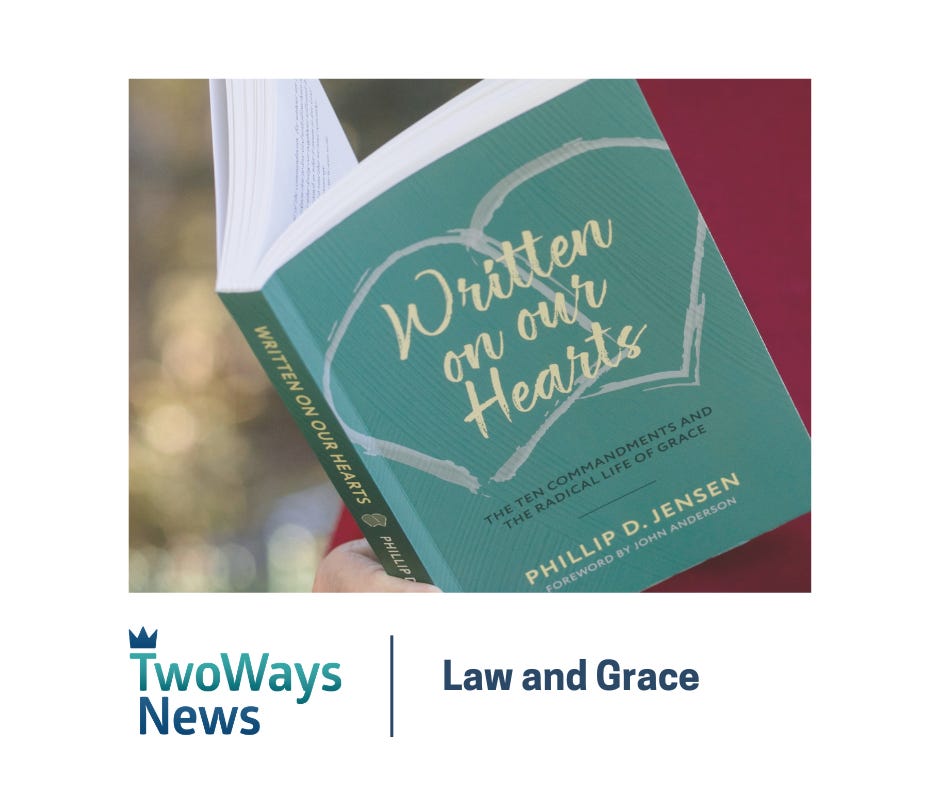
Peter: That leads us to the reason why I have chosen this subject for our first episode of this particular series, and that’s because I’m reading a book on the subject called Written on Our Hearts2 by Phillip D. Jensen. Phillip, you’ve written a book!
Phillip: I have. You’ve only read the first third of it so far—that is, the section called Grace and Law. In fact, the subtitle of the book is The Ten Commandments and the Radical Life of Grace. But the rest of the book takes us through the Commandments one by one to see how a citizen of the Kingdom of God—by the grace of the Lord Jesus Christ, inspired by the Spirit to keep the law on their heart—would approach keeping the law now. For example, Sabbath-keeping is so difficult in a society where some of us work seven days a week. How do we keep the Sabbath when we’re not in a theocratic society that acknowledges that Sabbath? That’s a significant issue, but we can’t just set aside the Sabbath as if it doesn’t matter. It mattered to God. He kept the Sabbath when he created the world. So how do we keep the Sabbath today as Christians? And then what does it mean to covet? I don’t think coveting is sin. In fact, coveting is a good thing in most cases. So why is there a Commandment on coveting, and what does it mean to covet? The two-thirds you are yet to read, Peter, have many surprises yet to come.
John Newton, Amazing Grace, 1779
Phillip D. Jensen, Written On Our Hearts, 2026 (Matthias Media).
Scripture quotations are from The ESV® Bible (The Holy Bible, English Standard Version®), copyright © 2001 by Crossway, a publishing ministry of Good News Publishers. Used by permission. All rights reserved.
Links & Recommendations
For more on this topic, check out this talk given at Camp MMM called The Great Commandments.
Freely available, supported by generosity.
If you enjoy Two Ways News, why not lend us a hand? Consider joining our Supporters Club—friends who make it possible for us to keep producing this article/podcast.
To join the Supporters Club, follow the link below to the ‘subscribe’ page. You’ll see that there’s:
a number of ‘paid options’. To join the Supporters Club take out one of the paid ‘subscription plans’ and know we are deeply grateful for your support!
also the free option (on the far right hand side)