Dear friends,
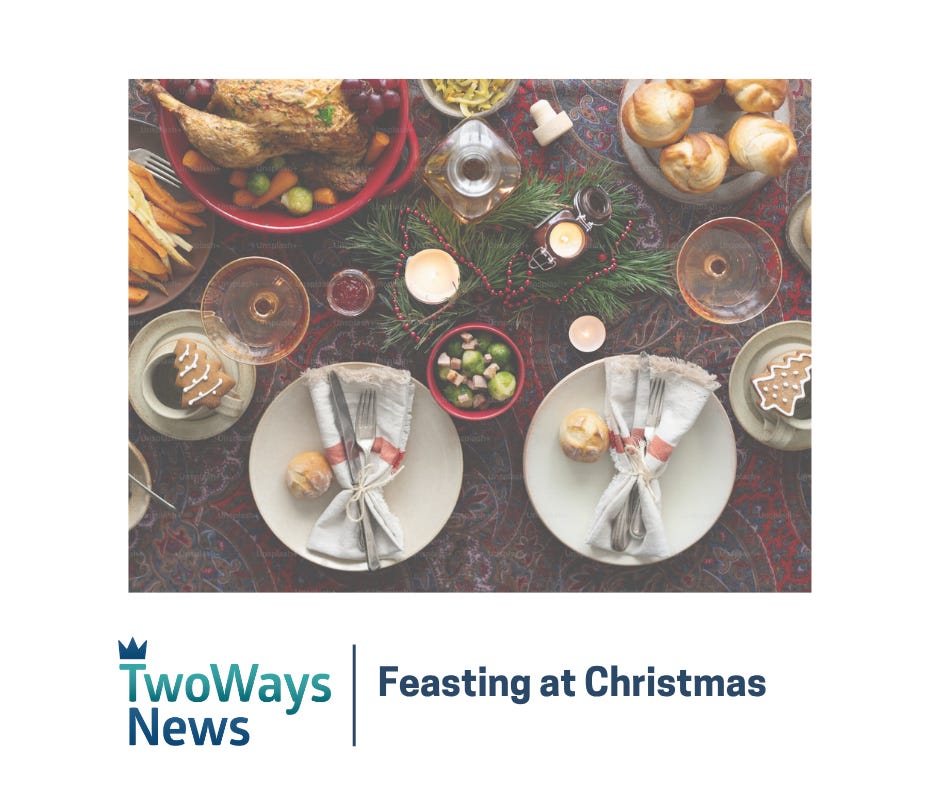
There are many Christmas traditions that I happily do not practise, from sentimental Christmas songs to reindeer, trees, and Santa Claus. However, I would never forgo the glory of eating a great feast at Christmas time, for eating food together is the God-given expression of fellowship, and Christian fellowship is derived from God sending his Son into the world to save sinners. Read on to see how Peter and I remember our Christmas festivities and have come to understand the importance of food at this season.
Yours,
Phillip
Phillip Jensen: Here we come to Christmas time once again. It is a nostalgic time for all people.
Peter Jensen: It surrounds itself with stories and tales.
Phillip: Most people recall Christmas in terms of their childhood. It was a universally happy time; you were allowed to eat things which you ordinarily weren’t, you got second helpings of ice cream, there were presents, and there were relatives whom you wouldn’t normally see. It was during the holidays, too, and for us in Australia, there was warmth in the air. Do you remember Christmas Day when we were children?
Peter: I remember that we had a big lunch which included a pudding with real money inside. In our family, there was a tradition where the money was collected up and invested in a lottery ticket. We did win five pounds once, but of course we do not commend such gambling!
Phillip: Indeed. But for many people, Christmas Day is a very difficult time. Some years ago, I spent some time talking to a casino boss, who said that Christmas Day was the busiest day at the casino. On that date, he would see around 25,000 people there. They were alone, bored, and playing with machines because they had nowhere to go for Christmas. He found that profoundly sad, having left his family’s Christmas gathering.
Peter: It is particularly sad because of the contrast between our Christmases as children and our Christmases ever since, and the reality of this day for so many people. The joy of sitting around the table eating is not just about the food; it is about the fellowship of eating. It is hard if you have to eat alone, particularly when you know that you have eaten with others in the past. Or you may eat with others, but you look around the room and think of people who are missing. It might be a husband, a wife, a child, or a friend who is missing, sometimes because death has taken them. The first Christmas after a death is always hard. But death is not the only cause for people around the table to be missing, of course. Sometimes it’s because family members have fallen out with one another. Commonly, a mother wants to get all her children together, particularly on Christmas Day, which is wonderful. But sometimes, having a family in which there are big tensions between people makes being around the same table difficult.
It is interesting that eating together is such an intimate activity that signals unity and peace with the ones you are eating with. But when the peace is make-believe in order to make a parent or other family member feel better, it’s very difficult. Though of course, that coming together means there’s also an opportunity for forgiveness and reconciliation. I know of one family which had grave problems, but after considerable work, they all came together and ate with each other. It was a remarkable and unforgettable moment that signalled the end of warfare and the beginning of reconciliation. There’s a natural oneness in shared food which is hard to ignore. That’s why people sometimes attend a wedding but leave before the reception. Food matters, not because it’s just a fuel in our bodies, but because of what it signifies.
Phillip: That communality is an important thing which is culturally difficult in western society. We had a group come to a conference one time who stopped at McDonald’s on the way. An interesting conflict took place, because one of the Asian members in the group thought that the McDonald’s was meant to be shared with everyone else, whereas everybody else bought their own. She was quite miffed that no one was taking from her or offering their food to her. When we eat at the same table, we are sharing one meal. It’s like all drinking from the same coffee or tea pot. Sharing matters, because the eating of a meal is not only about the fuelling of the body; it is about the inherent fellowship that comes with sharing.
If you only intend to fuel the body, stand in front of the fridge and graze. But if you’re going to sit at the table, you should be in fellowship with one another. That’s why table manners are so important to us. Our great aunt was fierce on table manners, which I am grateful for, because she taught us the essentials of fellowship with others when eating a meal. She taught us that you don’t start until everybody’s there, you don’t start until you’ve said grace, and that when the dessert comes, you don’t start eating until the person who served it has their helping. Because of these rules, we could all eat together.
Peter: The story about the McDonald’s reminds me that other cultures, particularly those of Asia and Africa, still have something which we have lost: the importance of food. When I go to an Asian church, for example, inevitably there’ll be dinner afterwards. Conversely, in many of our Anglo churches, we may have a dry biscuit and a cup of coffee. Fortunately that is now changing, but we Anglos don’t fully understand the significance of food.
Phillip: This sense of fellowship through food is found within the Bible.
Peter: Of course, food is at the beginning of Genesis, with the fruit of the garden. That signals a fellowship with God. I also think of the elders being summoned to eat in Exodus, when the covenant with Israel is made and when the Ten Commandments are given. The elders are gathered at the mountain, and after the covenant has been made, they eat and drink in the presence of God as a sign and seal of the covenant. You can do various things to sign and seal a covenant; for instance, a married couple is given rings. But in those days, when a covenant was made, you had an unforgettable meal together.
Phillip: I also think of the Passover. Before the Israelites came to Mount Sinai, they were enslaved in Egypt. During the last plague, they ate a sacrificial lamb together. The blood of the lamb was spread on the doorposts, and they ate the meal, dressed up and ready to leave. The Passover was to be eaten every year to remind the people of that famous meal that was had when they were saved.
There is also an instance where the people complain about the lack of food in the wilderness, and God provides manna as a sign of his grace and his sustenance to the people. God reminds them that man doesn’t live by bread alone, but by every word that proceeds from the mouth of God. It is the mouth of God that provides the food that makes it possible for them to survive in the wilderness.
Peter: It is significant that the Passover and the provision of manna in the wilderness both point towards the coming of Jesus. As God fed the people in the wilderness in the Old Testament, so Jesus fed the people in the wilderness in the New Testament. Then Jesus said, in John 6:51
I am the living bread that came down from heaven. If anyone eats of this bread, he will live forever.
Phillip: How do you eat of Jesus?
Peter: You eat of him by faith; as you put your trust in Jesus, so you are feeding on him, the bread of life. Food becomes a symbol of the very essence of Jesus, in the sense that when we have put our faith in him, we feed on him; thus, we owe our very lives to him. It is interesting that John’s gospel does not recount the story of the Last Supper. Instead, it recounts that saying of Jesus. This is because the Last Supper is intended to point to the feeding on Jesus, rather than being the feeding itself.
Phillip: The Passover was the appropriate time for Jesus to die, for he died as the Lamb of God that takes away the sin of the world. He was the Passover Lamb. Therefore, to understand the salvation that Jesus won, you must look back to the salvation that God won in Egypt, where the blood of the lamb meant that the Angel of Death passed over that house. So the blood of Christ means that judgement passes over us; forgiveness and salvation from our slavery to sin take place because of the Passover Lamb who was sacrificed for us.
Today, we remember that great Passover by celebrating what we call the Lord’s Supper. On this occasion, we are reminded of what Jesus did on the cross for us, of the promises of salvation as a result of his sacrifice, and of the new age, where we love one another as God has loved us. The Lord’s Supper is our Passover meal, reminding us of what Jesus, the real Passover Lamb and the real Passover meal, was all about.
Peter: It’s intriguing that there was a traitor present during the meal. The ignominy of Judas, the awful corruption of human life that we see in him, is caused by what he did. But it’s also significant that he had been eating and drinking with the one that he was going to betray. That is terrible.
Phillip: It’s because love is at the heart of the meal. In 1 Corinthians 11, Paul chastises the Christians of Corinth for not celebrating the Lord’s Supper properly, because they are not loving one another. One person goes ahead and eats, while the other is yet to arrive and is still hungry. It’s the failure of our Aunty Dot’s good manners. You should sit and wait until everybody is served, because that is the way to treat each other properly.
Peter: As Paul says in that very passage, the meal is the portrayal of the cross of Christ. In this, you proclaim the death of Jesus, through which we are all forgiven and forgive each other. By failing to love one another, you manipulate and desecrate the Lord’s Supper by not observing the body of Christ. In our churches today, the Lord’s Supper is eaten symbolically. It is a portrayal of a reenactment of the gospel of God’s grace, as well as a sign and seal of the new covenant of forgiveness in his blood, as people eat and drink together and are reminded of the death of Jesus. Of course, we receive Jesus not by chewing bread, but by faith.
Phillip: I do feel the abstraction in the symbolic nature of the way we serve the meal in our church gatherings. We have reduced it down to a small piece of bread and a small drink of wine or juice. It means that we concentrate on the body of Christ in terms of his physicality, rather than in terms of the congregational activity. Within our Anglican tradition, we are not to be celebrating this alone but in fellowship with other people. We are all meant to participate in it.
Peter: Sometimes we forget that there is a strong exhortation to be at peace with each other and to avoid partaking if you are not at peace. The prayer book also asserts that it’s not the consecration of the bread and wine that is important; it is the eating and drinking of the bread and wine. We take it in remembrance that Christ died for us, and we feed on him in our hearts by faith.
Phillip: I believe that we have reduced the meal down to such symbolic abstraction that we have moved away from the loving fellowship of sharing a meal together. Our Asian friends who eat together straight after their church services are in some ways closer to this fellowship than our liturgical meal.
Peter: Indeed. Are there other instances in the New Testament where food matters?
Phillip: Jesus often talks about feasts as a character of life. There are the instances of the feeding of the 4,000 and the 5,000, but he also talks in Luke 15 of a feast in the parable of the prodigal son that the father has to celebrate his son’s return. That’s a wonderful exhibition.
Peter: Luke 15, to which you’ve just referred, is very interesting because it begins with Jesus eating and drinking with tax collectors and sinners. The moralists of the day are shocked by his mixing with such people. Jesus points out that there is more joy in heaven over one sinner that repents than over 99 sheep that stay in the fold. Then, as you rightly pointed out in the parable of the prodigal son, the son comes home, and far from being treated in the way he should, there’s the equivalent of a wedding feast for him.
Phillip: It’s wonderful. That’s what younger brothers who return home in repentance should receive. There’s also the parable of Lazarus and the rich man, where Lazarus dies and is with Abraham at a feast in heaven. Heaven is a joyous place of fellowship; therefore, it is a place of food and pleasure in eating together.
Peter: So what about Christmas dinner?
Phillip: Christmas dinner is the celebration of one of the great things that we have. Easter and Christmas are the great celebrations of Christianity, where we celebrate the Lord Jesus Christ, who came into the world to save sinners and by his death and resurrection did so.
Peter: It’s not just a meal; it’s a meal for a particular reason.
Phillip: Yes, we rejoice that the Saviour has come by having this grand feast at Christmas. It’s like a wedding feast; I can rejoice over the food that I am eating, but the purpose of the meal is to rejoice over the couple that is married. Likewise, I can rejoice over the marvellous food provided on a Christmas meal, but the meal is for the purpose of rejoicing that Jesus has come for salvation. That is why inviting other people into the meal is so important. Jesus said in Luke 14:13–14
But when you give a feast, invite the poor, the crippled, the lame, the blind, and you will be blessed, because they cannot repay you. For you will be repaid at the resurrection of the just.
This Christmas time, as you look around your church, see who will have difficulty eating with others on Christmas Day, and invite them to join your own Christmas meal, because that is the nature of God’s generosity. He has invited us into his heavenly feast, so let us be generous to invite others into our earthly feast as we celebrate this Christmas.
Scripture quotations are from The ESV® Bible (The Holy Bible, English Standard Version®), copyright © 2001 by Crossway, a publishing ministry of Good News Publishers. Used by permission. All rights reserved.
Links & Recommendations
For more on this topic, check out this sermon by Phillip called The Two Feasts of Sinai.
🎁 Support us by giving a Gift Subscription
If you enjoy Two Ways News, why not lend us a hand? Consider gifting someone you know a subscription to our Supporters Club—friends who make it possible for us to keep producing this article/podcast.
To gift a subscription to the Supporters Club, follow the link below to the ‘subscribe’ page. You’ll see that there’s:
a number of ‘paid options’. To join the Supporters Club take out one of the paid ‘subscription plans’ and know we are deeply grateful for your support!
a Gift option
also the free option (on the far right hand side)