Dear friends,
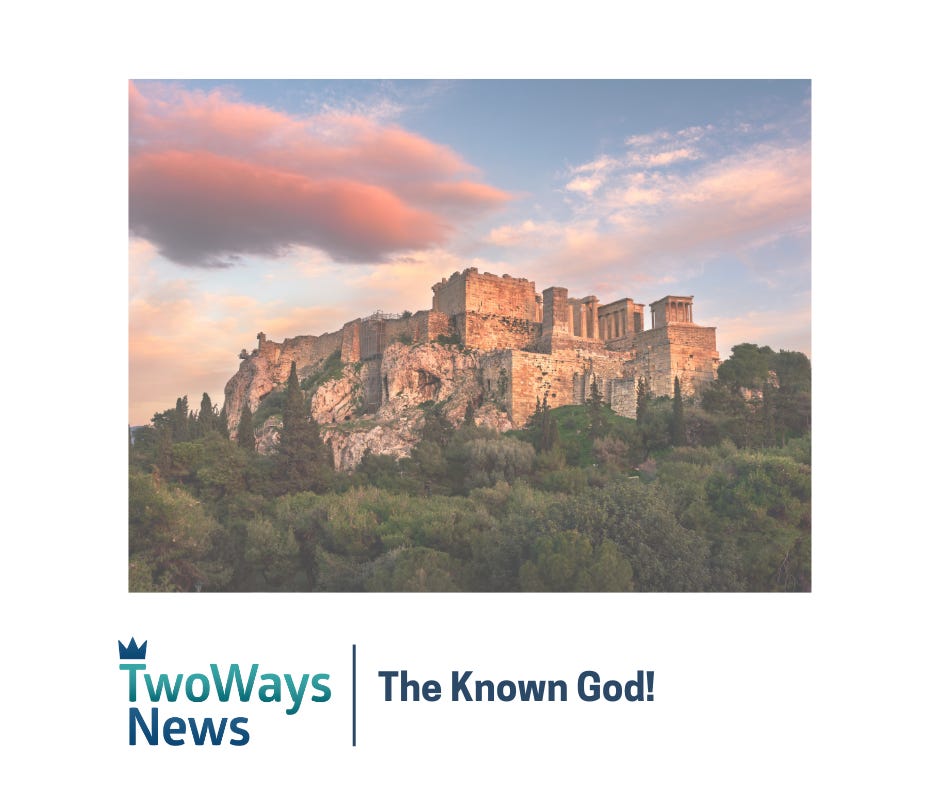
Welcome to a New Year. We are commencing Two Ways News’ summer series today, looking at evangelism through the study of Paul’s famous sermon on the Areopagus of Athens in Acts 17.
Yours,
Phillip
Phillip Jensen: In this summer series, we will look at the great evangelistic sermon in Acts 17, where Paul delivers a speech on the Areopagus in Athens.
John Stott’s The Message of Acts1 in the commentary series The Bible Speaks Today breaks this sermon into 5 points about who God is: the creator of the universe, the sustainer of life, the ruler of the nations, the father of humans, and the judge of the world. Our series will discuss these 5 great points from this sermon. Acts 17:22–25
So Paul, standing in the midst of the Areopagus, said, “Men of Athens, I perceive that in every way you are very religious. For as I passed along and observed the objects of your worship, I found also an altar with this inscription: ‘To the unknown god.’ What therefore you worship as unknown, this I proclaim to you. The God who made the world and everything in it, being Lord of heaven and earth, does not live in temples made by man, nor is he served by human hands, as though he needed anything, since he himself gives to all mankind life and breath and everything.
This passage hits the first 2 of John Stott’s points: God is the creator of the universe, and God is the sustainer of life. But it’s an interesting sermon due to its audience. The people of Athens were everlastingly interested in the latest ideas; the Epicureans, the Stoics and the philosophers in particular wanted to hear more of this new preacher. Paul preaches the same gospel here as he does elsewhere, but the audience shapes the presentation of his truth.
Peter Jensen: We learn something here about the flexibility needed in the preaching of the gospel. It is important to take account of the audience. That sounds simple enough, but we don’t always do this. If you compare the Apostle Paul’s preaching to different audiences, you’ll see that while the message stays the same, he shapes it to the audience. He knows the audience, so he moves from what they know to what they don’t know. That’s a very good rule. Interestingly, of all his sermons, this one speaks to our own situation; the Epicurean philosophy in particular is alive and well today, thus the situation in Athens is similar to our own. There was in Athens an intellectual pride, and there was idolatry, which included an image of ‘the unknown god’.
Furthermore, the Athenians were seeking to have a discussion with this man who came preaching foreign deities, based on contempt for the preacher and their fascination with new fashions. There’s a lot there that is so human, that speaks to us of our own age. Through this, Paul sends the arrow of the gospel into that context.
Phillip: Paul is called by the Athenians ‘the babbler’. It’s a derogatory term; Paul is not coming as the great preacher but as someone that they hold in contempt, for he is of no significance to them. In his sermon, he starts by addressing this idolatry issue, which is not at the heart of either the Epicureans or the Stoics, but is certainly at the heart of Athens. In fact, the reason he was in the streets preaching before this event was because when he was in Athens alone, he was provoked by the amount of idolatry he saw. It’s always a challenge for us to realise how upset Paul was about how pagan the people of a pagan city were. We ourselves live in a pagan city of sorts, but because our society has Christian roots, we do not seem to be as upset by the idolatry of our society as Paul was.
Paul starts with the idols and with religion, addressing their idol of ‘the unknown god’. He refers to the audience’s self-acknowledged ignorance, saying in essence, ‘You say you do not know this god; I will tell you about him.’ He then tells them of the true and living God and the implications that has for religion.
Peter: I’m no expert in religion; however, there are some things which strike me about it. An Indigenous student from Moore Theological College, on the subject of spirits, once told me, “If you were on your own in the bush for 2 days, you’d think there were spirits.” That idea that the world is inhabited by many spirits, some evil and some good, is probably the most common idea in the world even today. It is we, the inheritors of the Western tradition, who are the strange ones. Thus the world that the apostle is speaking into is still our world.
I recently had the great honour and privilege of hosting an African bishop here. I asked him about magic and sorcery, for that is the world from which he comes. He was involved in these practices until the age of 12, when he first heard the gospel and turned to Christ. But that view of the world, in which we are surrounded by gods and spirits, is very common indeed. The human heart longs for something more than simply this world; we long to have an explanation for it. We long to have some sense of purpose and meaning that comes from beyond ourselves. We need answers to questions like ‘who?’ and ‘why?’
Someone who worked in Papua New Guinea once told me that when an accident occurred or when someone fell sick, the question often asked was, ‘Who has done this?’ or ‘What spirit is behind this?’ There’s a sense of the world being inhabited with the spirits. So they would ask, ‘Who has done this, and why have they done it to me?’ We are surrounded in that world by mystery and religion. In saying ‘religion’, I am not talking about the Christian faith, but human religion, which helps people to cope with the mysterious. We need power; we need an ability to communicate with the dead and with the world around us. Religion puts us in touch with the supernatural, or so it is believed. I have never lived in that world, and I’m no expert in religion, but that’s how I understand the world in so many places, including the ancient world.
Phillip: It’s interesting to see the understanding that the Athenians had about Paul’s sermon. When they heard Paul preaching of Jesus and the resurrection, they thought he was speaking of foreign gods. Though Jesus is indeed God, the resurrection is not a god. They didn’t understand what he was saying, but it is interesting that they misunderstood in terms of gods and of religion. In other words, they lived in the world, as people have throughout human history, of gods and of spirits. It seems like the best way to explain the world, which to many people is chaotic. According to that view, there are many good and evil forces at work in the world, so people pray to the gods of healing or of travel, for instance.
This notion shows up sometimes in Christianity, wherein the different saints are assigned different activities to protect us. For instance, Christopher is supposedly the patron saint of travellers, and Luke the patron saint of healers. It’s a very natural religious response. For some of our audience, it may be somewhat confusing to hear Peter, as an archbishop, say that he is not an expert in religion. But religion is different from Christianity in this regard.
Peter: Indeed, but not by accident. That is to say, you can categorise Christianity as a religion, but there’s a standout feature in Christianity which is quite significant, though we take it for granted. I once asked our father, when I was six years old, “Are there any ghosts in the world?” to which he replied, “No, ignore that. That’s nonsense.” That answer was comforting to me, but what would you have said in response to this six-year-old?
Phillip: I would ask, ‘Why?’, as in ‘Why do you ask about these things?’ Because at that age, what you were getting at was where a lot of religion comes from: anxiety, fear, and impotence. It’s partly the understanding issue, the viewpoint that the world doesn’t make sense; it’s also the harm issue, the knowledge that the world seems to bring sickness, death, and all other kinds of suffering.
Peter: There’s a book called The Intellectual Adventure of Ancient Man2 in which there is a set of essays, one of which says this about ancient Egypt
The ancient Egyptian had a similar sense of a surrounding world of forces. A mother had to croon a protective song over her sleeping child… In an incantation against disease, the malevolent forces which may bring sickness include “every blessed male, every blessed female, every dead male, and every dead female,” that is, the dead who have attained a state of eternal glory, as well as those who have died without certainty of immortality.
This passage provides a sense of a world in which there were many gods, spirits, and forces, and a subsequent longing that people had to be protected. Some people also longed to control the forces so that they could use them against their enemies.
Phillip: Thus, the truth that Paul starts with is to go straight to who the true and living God is.
Peter: What he said was astonishing: he went straight to God, and he spoke about one God. The world in which the message of the Bible came is summed up in those wonderful first 4 words, “In the beginning, God”. In a sense, the Bible itself is summed up in that simple phrase. We cannot get the picture of how revolutionary those words are. The Bible does not say, ‘In the beginning there were many gods,’ or ‘In the beginning the gods had a fight and the world was the product of it.’ Nor does it say that the world is a result of sex between gods, or anything like that. There is one God, the maker of all things. The maker who makes by speech, who simply speaks the non-existent into existence. The one God, the maker of all things; the single will who rules the world.
The answer to the question, ‘Who is doing these things to me?’ is that whatever happens, it is the will of God. You’re not dealing with the many; you’re dealing with the one. This is good news, as it sets us free from the anxieties and the fears of the spirit-filled world. It’s an announcement of ‘the unknown god’ that Paul refers to. To quote once more from ‘The Intellectual Adventure of Ancient Man’
Israel’s greatest achievement, so apparent that the mention of it is almost trite, was monotheism. It was an achievement that transformed subsequent history. One may raise the question of whether any other single contribution, from whatever source since human culture emerged from the Stone Age, has had the far-reaching effect upon history that Israel in this regard had exerted through the mediums of Christianity and Islam, and directly through the world of Jewish thinkers themselves.
Israel’s greatest achievement is this phrase, “In the beginning, God”; that is, one God. We need to see it as the fundamental truth on which our society is built, as we have stopped recognising it as such.
Phillip: It is the fundamental reality upon which the gospel is built. When Paul preaches the gospel in Athens, with the diversity of views and the acknowledged ignorance of the unknown god, he immediately speaks of the true God, but then fills out the information. He essentially says, ‘I am talking about the one God who made the world and everything in it, being Lord of heaven and earth; not one of your many gods, but the true and living God.’ All of the gods of the Greek pantheon had limitations of various kinds. None of them were the Lord of the whole universe.
So Paul goes straight to this non-Jewish audience, the Gentile audience as we call it, and says in essence, ‘Now that you understand God, let me tell you about him.’ He then continues by filling out the details. The key point he makes is that God created everything; therefore, he doesn’t live in temples, and he is not under our control. He is the one who makes and rules everything. Church buildings are not temples; that is a difference between religion and Christianity. Because Christianity is monotheistic, there are not multiple different ways to this great God, as he rules over everything. He doesn’t live in temples. Though of course there is a temple in the Old Testament.
Peter: There is, and eventually there is one built in Jerusalem. It was, in a sense, the palace of God in Jerusalem, because there was the line of King David and the true king, God. But that temple was only a foreshadowing of what was going to happen through Christ, as were the sacrifices, the food laws, and all the rest. When Jesus comes, he tells us that the temple will be destroyed, but that it doesn’t matter, because in three days the temple will rise. In this context, he is referring to the temple of his body. I agree entirely that God is everywhere and that he doesn’t dwell in temples made with human hands.
Phillip: When Solomon dedicated the temple, he said in 1 Kings 8:27
But will God indeed dwell on the earth? Behold, heaven and the highest heaven cannot contain you; how much less this house that I have built!
The God who made everything does not live in temples. There’s a reason within the Bible for that, as you’ve pointed out: the reason is to help us to understand Jesus. In Revelation 2, in which the city of God is described, there is no temple, because we are with God. Therefore, the gospel is preaching the creator God of heaven and earth; we need to make that clear.
Peter: The idea of the temple turns up in the New Testament. It’s translated into the terms of Jesus, wherein he calls his body the temple. But the church is called the temple of the Lord.
Phillip: The church that is called the temple of the Lord is the people, for our body is the temple of the Holy Spirit, and we are the living stones being built into this temple. Metaphorically, the temple is where God lives. That is because God lives in us, as God lives in the Lord Jesus Christ and we are in him. The language of the temple is used symbolically, but never literally, of Christians and Christian life. But when Paul is preaching the gospel to literal temple worshippers, idol worshippers, and polytheists, his first and clearest point in Acts 17 is that God is the creator of all, the one God creates everything, and he doesn’t live in temples.
Peter: When you said the temple is metaphoric, you didn’t mean that his presence is metaphoric, but that the language of the temple symbolises his presence. He is present with us, but it doesn’t mean he’s not present everywhere else. The reason anything happens is through the will of God.
Phillip: But when it comes to gospel preaching, you have to start there.
Peter: That is where you started in ‘Two Ways to Live’.
Phillip: ‘Two Ways to Live’ is a gospel presentation that we wrote years ago. Some friends of ours were working at that time to look at what the gospel in the book of Acts truly meant. They noticed that when they preached to Jews, there was no reference to the creator. It was assumed that the reason was because when they preached to the Gentiles, they started each time with the creation and the Creator, whereas the Jews already knew of the Creator. Thus, they realised that an understanding of the creation is needed to understand the gospel.
The first time I was taken out to do street evangelism, the man who mentored me chatted to a student. He told the student that God loves him, and the student responded and continued talking. Afterwards, I asked my mentor, “How did you know he believed in God?” My mentor said, “Unlike you, I believe in the Bible.” I asked what he meant, to which he replied, “God says in the scriptures that people know God exists. It’s you who doubts that God exists; I just assume that the people we evangelise to will be like the Bible says: believers in God. If they’re not, they’ll tell me. But what they know about God is confused and wrong. Paul doesn’t start on the ‘if’; he just says, ‘I’m telling you about God.’”
Peter: Paul says, ‘I’m telling you about the unknown god that you believe in.’
Phillip: You need to know who God is, the creator of all; otherwise, you will not understand sin as being rebellion against God. You will reduce sin down to rules and regulations, cultural norms and mores. If you don’t understand sin, you won’t understand why God judges us. If you don’t understand judgement and sin, you’ll never understand Jesus and his death on our behalf to turn aside the righteous anger of the creator God.
John Stott, The Message of Acts, 1990 (InterVarsity Press)
H.A Frankfort, The Intellectual Adventure of Ancient Man, 1946 (The University of Chicago)
Scripture quotations are from The ESV® Bible (The Holy Bible, English Standard Version®), copyright © 2001 by Crossway, a publishing ministry of Good News Publishers. Used by permission. All rights reserved.
Links & Recommendations
For more on this topic, check out this talk by Phillip on Acts 17. It’s called How To Know God.
Freely available, supported by generosity.
If you enjoy Two Ways News, why not lend us a hand? Consider joining our Supporters Club—friends who make it possible for us to keep producing this article/podcast.
To join the Supporters Club, follow the link below to the ‘subscribe’ page. You’ll see that there’s:
a number of ‘paid options’. To join the Supporters Club take out one of the paid ‘subscription plans’ and know we are deeply grateful for your support!
also the free option (on the far right hand side)