Dear friends,
As Peter and I consider different topics of Christian concern, it is sad to see how often old problems keep on being recycled through our churches. One such issue is that of assurance. Assurance of salvation is such a fundamental blessing of the Christian life and such a litmus test of authenticity. It is both sad and surprising to see it being questioned once more.
I hope this exploration of assurance will assist you not only in believing but also in caring for others who struggle with the gospel.
Yours,
Phillip
Phillip: In this week’s episode, we are going to explore the topic of assurance.
Peter: I have regarded assurance as one of the key topics of the last several decades.
Phillip: It’s also a key topic for evangelicalism. When we come to define ‘evangelical’, most people use the work of David Bebbington, who says that there are 4 aspects of evangelicalism: Biblicism, Christocentrism, Conversionism, and Activism1. But while that is a true sociological description of evangelicalism, it doesn’t capture the heart of it. Bebbington describes what evangelicals do, say, and believe, but he doesn’t tell us what drives them. On the other hand, journalist John C. King’s 1969 The Evangelicals2 says that evangelicals are “people who know that they are saved.” At the very heart of evangelicalism is this conviction, this assurance of salvation. I think that is a better way of understanding what evangelicals are, rather than just what evangelicals do or say.
Peter: Interestingly, it distinguishes evangelicals from other Christians.
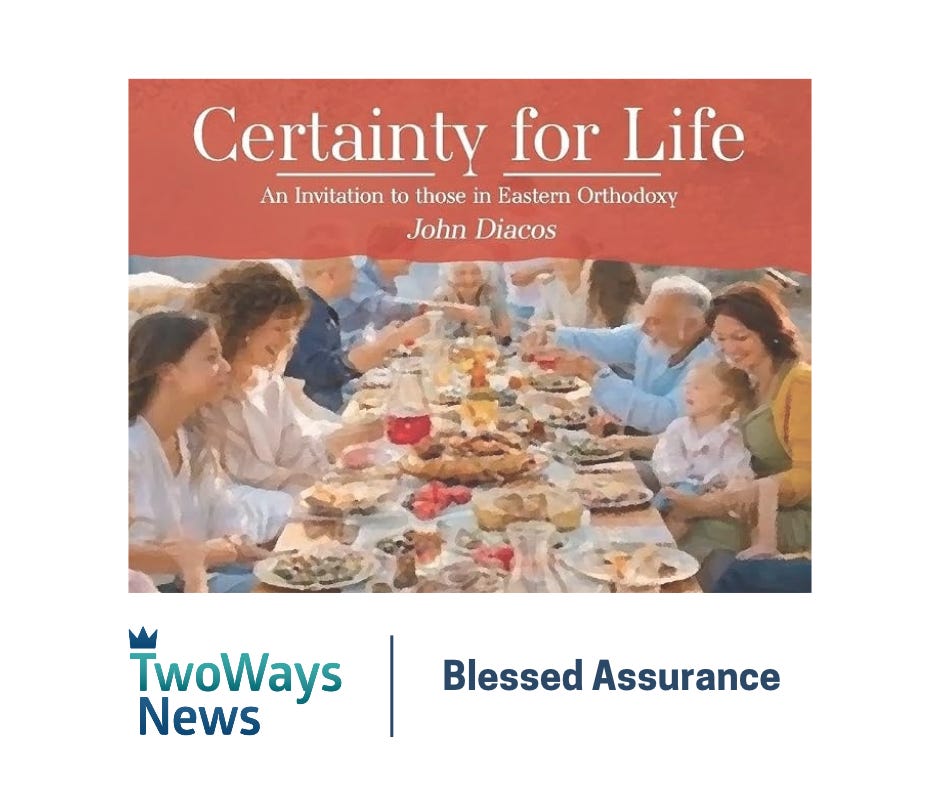
Phillip: Indeed. There is another book published more recently, Certainty For Life3 by John Diacos, which teaches us how to share the gospel with our Orthodox friends, Diacos himself coming from a Greek background. Interestingly, it starts with the topic of certainty, which is another word for ‘assurance’. He says that the failure of his Orthodox background was to give him any certainty about God, and the gospel has opened up for him the wonderful relationship with God that you can have once you’ve come to terms with the certainty that the gospel gives. I know you’ve written an essay about assurance recently, so that’s why I thought we would explore it today. You and I were raised on that old hymn, Blessed Assurance. The Billy Graham organisation used that one a lot.
But it begs the question: what is assurance? And is assurance different to faith, or is assurance an additional experience over and above faith? Moreover, how do we obtain assurance? When I wrote Just for Starters,4 which is a series of basic Bible studies for new Christians, I remember that we decided to write the assurance study on Romans 5:1-11
Therefore, since we have been justified by faith, we have peace with God through our Lord Jesus Christ. Through him we have also obtained access by faith into this grace in which we stand, and we rejoice in hope of the glory of God. Not only that, but we rejoice in our sufferings, knowing that suffering produces endurance, and endurance produces character, and character produces hope, and hope does not put us to shame, because God’s love has been poured into our hearts through the Holy Spirit who has been given to us.
For while we were still weak, at the right time Christ died for the ungodly. For one will scarcely die for a righteous person—though perhaps for a good person one would dare even to die—but God shows his love for us in that while we were still sinners, Christ died for us. Since, therefore, we have now been justified by his blood, much more shall we be saved by him from the wrath of God. For if while we were enemies we were reconciled to God by the death of his Son, much more, now that we are reconciled, shall we be saved by his life. More than that, we also rejoice in God through our Lord Jesus Christ, through whom we have now received reconciliation.
It’s a great passage, but where do you start on the topic of assurance? You wrote about an assurance deficit which is present in Christian circles.
Peter: I did, in a journal called The Global Anglican (though it used to be called Churchman). I wrote an editorial called The Assurance Deficit,5 which struck me when I began ordained ministry back in 1969, at the end of what you may call ‘the long 1960s.’ This 1960s revolution changed so much in society, as well as our churches. During that time, I once talked to a young lady who said to me, “Peter, I have doubts.” So I brought out the proof for the existence of God, and she looked at me and said, “No, Peter, that’s not what I’m doubting. I’m doubting whether I’m saved or not.” I suddenly realised that this was a major problem, and it always had been. It was so common for evangelicals and other Christians to ask, “Am I really saved?” Because your sense of guilt that your sins are still going on is so strong that you begin to ask whether God can save such a guilty person as you. So that was the issue, and one which we had to address.
In a sense, though it certainly hasn’t gone away, I counted it as a 1950s question, because in the 1960s there was a new wave of doing things, and with it came a new set of questions. It wasn’t so much “Am I saved?” but “Is there a God at all?” and “Can I have an experience of God?” Famously in 1966, on the front page of Time Magazine was written the great question, “Is God dead?” That was the issue that younger Christians in particular were asking. But they weren’t so interested in proofs for the existence of God; they were interested in experience. They wanted to know, “Can I experience God? Can I know firsthand that he is there?” I personally believe this had a great deal to do with the rise of the charismatic movement, born of Pentecostalism inside the mainstream churches. Up until then, Pentecostalism had been rather looked down upon in the Protestant mainstream churches. But lo and behold—within the churches themselves, this charismatic movement arose, which offered experiences of God.
Phillip: Are you saying that the charismatic movement led to the question of “Is there a God?” Or did the question lead to the charismatic movement?
Peter: The latter. It was the question “Is God there?” that opened the path to the power of the charismatic movement, which offered experiences to demonstrate that God was there. There are 3 main reasons that I can think of which explain why Christian assurance may drift away:
1. Guilt. “Am I good enough?”
2. The loss of God. “Can’t God show himself by dreams, by experiences?”
3. Suffering. “If God is God, why am I suffering so much while others aren’t? Am I a worse sinner than them?”
You can imagine that those 3 elements—guilt, loss of God, and suffering—raise issues to do with assurance. So the question arises: how do we heal doubt? Over the years, your mention of John Diacos and his experience in Orthodoxy was interesting to me, because of the Council of Trent in 1547, which was the Roman Catholic answer to the Protestant movement of those years, and which still has considerable power in shaping Roman Catholic theology. The Council of Trent stated that we Christians cannot have assurance. Of course, that is absolutely true if salvation depends to some extent on your good works, because how can you be sure that you have done enough? Hence the need also for purgatory. So then justification becomes not a moment in which you are justified, but a process that goes on. So then salvation comes from not just faith alone, but faith and love—faith and the things you do. It’s not that they have done away with the cross, but they have added to the cross the works that you must do as a Christian. So naturally, in that system of thinking, it would be impossible for you to have assurance.
Phillip: This way of thinking is not necessarily exclusive to Catholicism, but it winds up in the same place. If you say you come into Christianity through the cross, but you are kept in Christianity by your good works, that undermines assurance of salvation.
Peter: Yes, and there are instances of that going from the 17th century in Protestant thinking as well. Indeed, in the 17th century, within the so-called Puritan movement, there were those who argued for a kind of two-stage process of coming to faith and then gaining assurance as a second blessing, if you like, when you had put your life in order.
Phillip: Indeed, but I also think of the 20th century with the introduction of a new perspective on Paul. That moves you again to the idea that you must stay in Christianity through your good works, and therefore assurance gets undermined again.
Peter: Anything of that nature makes justification by faith doubtful, thus robbing you of assurance. That’s simply logical. There was a second approach to the problem of assurance, which was aimed at the people asking “Is God dead?” This approach is through what I call ‘Experiential Christianity’: miracles, healings, speaking in tongues, prophecy, slaying in the Spirit. This was taken together with the ‘power of faith’, as though faith is a sort of lever which, if you pull the right way, will cause blessings to flow out. It’s this idea that if I have the right experience, I can be assured that God is there. But there are problems with this.
Phillip: You’re not denying that experiences happen, are you? For they can have some contribution to our assurance. What about God’s providence? What about God’s answering of prayers? If I remember the writing of John Stott about 1 John,6 there’s this sense that the love of the brethren is the sign of our assurance. Each of these things happen, but what they mean—how we read and understand our experiences—seems to me to undermine the idea that we can get assurance from experiences.
Peter: Yes. I guess many of us, myself included, can report certain instances of seeing the Lord walking with us in answers to prayer, in providences, in blessings. I think of them as flowers on the wayside to remind me that he is still with me. But then you go through a mental desert, a desert of suffering and pain in which God seems to absent himself. What then?
Phillip: Indeed. Sometimes, we see that God answered our prayer, but not necessarily in the way we expected. But what happens when I don’t see my prayer answered?
Peter: Indeed, I’ve been praying for some people for 60 years, and I haven’t yet seen any evidence of those prayers being answered. There’s also the interpretation of these other experiences, like prophecy, healing, and speaking in tongues, which you and I have talked about in the 1 Corinthians material. You can talk about the healings, but what about the people who aren’t healed? Some people think people aren’t healed because they don’t have enough faith. Is that a proper understanding of faith? Or are you thinking of faith as a power which gets things done? In which case, you’ve misunderstood faith.
Our father lived in Cowra in the 1920s, and there was a ‘faith healer’, as they were called, who came to Sydney. There was a man who had broken his arm, and it was permanently misshapen. He was a very godly man, known as the best Christian in town. So off he went down to Sydney to have his arm healed. But when he came back, his arm was not healed, and people asked him, “What happened? Why wasn’t your arm fixed?” And very sadly, our father remembered, word-for-word, the man saying, “I didn’t have enough faith.”
Phillip: That’s awful.
Peter: It’s tragic—if this godly man did not have enough faith for something as simple as getting his arm fixed, how can we have enough faith to be saved? Can my sin be removed? That’s a misunderstanding of what faith is. Faith submits itself to the will of God.
Phillip: Yes—in fact, there’s been a shift from talking about ‘faith healing’ to ‘divine healing’. That’s a better phrase for understanding God’s healing.
John Chapman used to tell a story about the time when he was in Moree. There was a tent mission there, and he brought along his youth group, who were fairly unbelieving at that stage, to see this great faith healing exhibition. When they were there, a man supposedly had his eyesight fixed—and he yelled with joy, threw his glasses away, turned around, and walked straight into a tent pole. At that point, Chappo’s youth group erupted into such laughter that he had to remove them from the tent.
Peter: For those who didn’t know John Chapman, that is a typical story from him. It’s how you interpret the experience, what it really amounted to, whether it was an accident—all those things.
Phillip: But we have to get back to faith, to work out what faith is and how it connects to assurance. This passage in Romans 5 talks about justification by faith, which enables us to have peace with God. So we, by faith, are now in the grace of God, and we have hope because of this faith. What do we mean by the word ‘faith’ itself? It’s not superstition, like how so many of the new atheists of the 21st century treat it. They weren’t the first to do that, though; the American humorist Mark Twain once wrote that faith is about believing things which you know are not true. But that superstition is not what we mean. Nor is it a lever to force God to do things, nor is it the one good meritorious work. Some say, “I’m not saved by my works, I’m saved by faith, but faith is my work.”
No—faith is only as good as what you have your faith in. Faith always needs an object. You put your faith in the bus driver, in the chair you’re sitting in, in the doctor or especially the dentist. When I go to the dentist, I let him inflict pain upon me because I trust that he knows what he’s doing. I trust that he will make it better for me. And I trust he will charge me a lot of money afterwards. But faith just means ‘trust’. That’s fundamentally what it’s about. As such, it’s a word that everybody uses because we trust each other all the time.
Peter: There’s no science without faith.
Phillip: A person who doesn’t trust knows nothing and has no friends, because you need trust to know anything, and you need trust to have friends. Assurance is faith; it is trust, properly considered. That is, assurance is an expression of faith, like prayer is an expression of faith. When I pray, I’m trusting God with the issue. I’m handing it over to him. Our assurance is really just faith properly considered. It’s not like once you have faith, you must have assurance. That view you mentioned of a couple of centuries ago is not what faith is. Faith is trusting God.
But does faith always have 100% certainty? Do you need to have that kind of absolute, pure faith? No—Jesus said that if you have faith as big as a mustard seed, you can move mountains. I don’t think Jesus is teaching us a new mountain-moving ministry. What he’s saying is that the size of faith, the ‘quality’ of faith, is not the issue. It’s whom you have your faith in that matters. If I have my faith in God, God can move whatever mountain God wishes to move, and I can trust him with it. There’s nothing too big for God to deal with. That’s why ‘divine healing’ is much better than ‘faith healing’; it’s not my faith that heals, it’s God who heals, which is why I trust him. Furthermore, I do have a healing ministry in the sense that when I get sick, I always pray for healing. And the more painful my sickness, the harder I pray.
Peter: We also pray for others who are sick.
Phillip: I’ve never been in a church that doesn’t pray for the sick.
Peter: No—as long as we remember that faith means seeking the will of God. He’s the one with the wisdom, not us, and he knows what he’s doing.
Phillip: Because as you mentioned earlier about Experientialism, if you don’t get the right experiences, what happens? The right experiences are always favourable for me in terms of the pleasures of this world. Whereas Paul says in Romans 5 that we rejoice in our sufferings. I think the Experientialist would say, “We get rid of our sufferings.” But no, Paul says that we rejoice in our sufferings because we know that God is at work in our sufferings. It’s through our sufferings that we have endurance and character and hope, and the hope we have in God never disappoints us because of what God has done through his Spirit. The work of the Holy Spirit is so important in this issue of trust, in our confidence in God.
Peter: Indeed it is. And thank you for making the point, which I agree with entirely, that faith and assurance are the same thing. The word ‘assurance’, which turns up occasionally in the Bible, is really just another way of talking about faith itself. And what this passage does, as you rightly point out, is that it takes us through our sufferings while saying that now that we have peace with God through our Lord Jesus Christ, we understand that God is at work even in our sufferings, producing in us likeness to Jesus. So we trust him in the midst of it. Then we come to Romans 5:5, “And hope does not put us to shame, because God’s love has been poured into our hearts through the Holy Spirit who has been given to us.”
I first read this as, “God has made me more loving.” But that’s the exact reverse of what Paul is saying. He’s saying, “Hope does not disappoint us because the Holy Spirit assures us of the love of God for us.” In other words, Christ Jesus loved me and gave himself for me. Then the passage goes on, “For while we were still weak at the right time.” How does the Holy Spirit remind us of the love of God? It’s not a tickle in the conscience or something like that; it’s by drawing us back to Jesus. How does this happen? At the right time, Christ died not just for me, but for the ungodly, you. He died for you, ungodly as you are. The passage expands this, saying that God shows his love for us in that while we were still sinners, Christ died for us.
There’s a marvellous moment in the Kenyan prayer book in which at the end of the service, there’s a set of sayings, and it goes something like this: “All my burdens, I take them to the cross. All my sins, I take them to the cross.”7 And so it goes on. That is to say, in the midst of trial and tribulation, in the midst of fear and anxiety about whether we’re good enough, our minds and hearts, guided by the Holy Spirit, must take us back to the cross of Christ. That’s God’s word to us, even when the night is dark.
Phillip: Yes, and that gives us the basis of the final part of this chapter. By the cross, we’re reconciled to God. We who are his enemies, we who are opponents, we who are weak; by his cross, we are reconciled. If we’re the friends of God, if we’re reconciled to God, we have a certainty, an assurance, a confidence about the future. For if God would send his Son to die for us—while we were enemies, while we were weak, while we were hostile—what will he do for us now that we are his friends? We’ve been reconciled at such cost to him, but now we can be absolutely assured that by the death of his Son, through his life, we are safe and secure in the hands of God. So our assurance lies in taking it all to the cross.
It changes another thing too, which comes out in John Diacos’ book. As long as you think you’re saved by good works, you are fearful of God. Not just in awe; you are terrified of what he’s going to do to you, and you don’t love him. But when you know he has paid the price for you at such a cost, and that you are now his friend, the face of God is turned to us with a smile.
Peter: Blessed assurance, Jesus is mine.
David Bebbington, The Evangelical Quadrilateral, 2021 (Baylor University Press)
John C. King, The Evangelicals, 1969 (Hodder & Stoughton Ltd)
John Diacos, Certainty For Life, 2025 (Ark House Press)
Phillip D. Jensen & Tony Payne, Just For Starters, 2020 (Matthias Media)
Peter Jensen, The Assurance Deficit. The Global Anglican, Volume 138/3 September 2024
John Stott, The Letters of John: An Introduction and Commentary, 2009 (IVP Academic)
Anglican Church of Kenya, Our Modern Services, 2008 (Ekklesia Society)
Links & Recommendations
For more on this topic, check out this talk given at St. Andrew’s Cathedral called The Great Assurance.
Freely available, supported by generosity.
If you enjoy Two Ways News, why not lend us a hand? Consider joining our Supporters Club—friends who make it possible for us to keep producing this article/podcast.
To join the Supporters Club, follow the link below to the ‘subscribe’ page. You’ll see that there’s:
a number of ‘paid options’. To join the Supporters Club take out one of the paid ‘subscription plans’ and know we are deeply grateful for your support!
also the free option (on the far right hand side)