Dear friends,
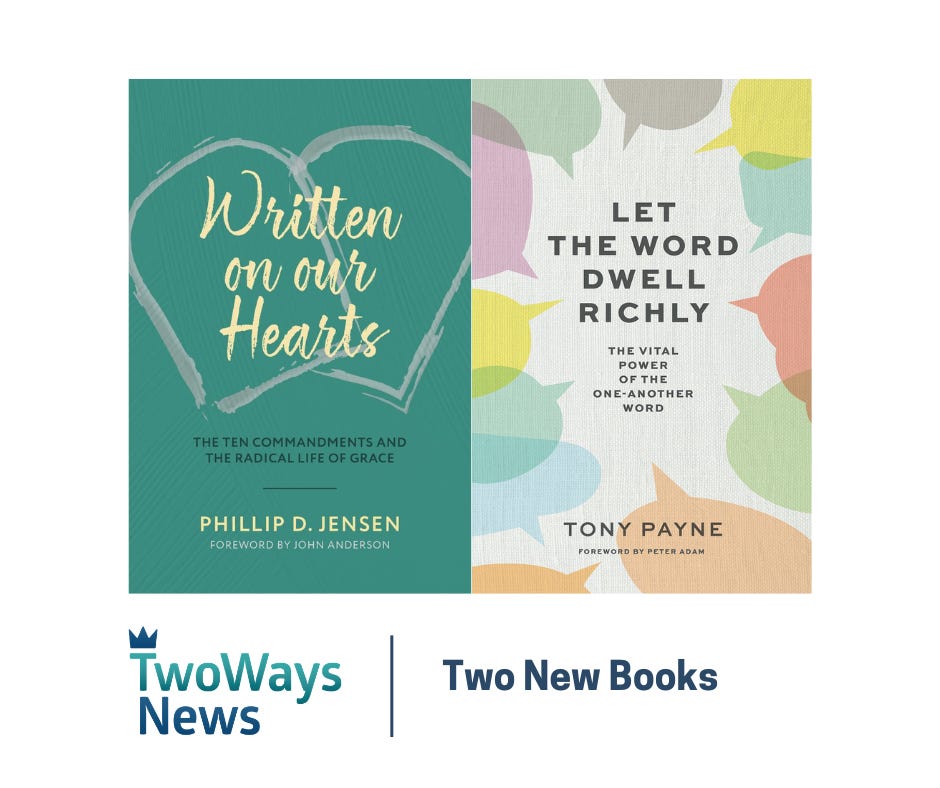
In this episode of Two Ways News, we welcome back Tony Payne, because each of us has published a new book this year. Tony’s book entitled Let The Word Dwell Richly helps us understand the great importance of ministering the Word of God to one another. My new book Written on our Hearts seeks to recover the Ten Commandments for those of us who are saved and live by grace. This episode is not simply an advertisement for these two books, but a discussion between us about the central concepts of our publications. I hope you enjoy the discussion—and that you buy and read the books.
Yours,
Phillip
Tony Payne: Hello, I’m Tony Payne, and welcome to a special crossover edition of the Two Ways News podcast and the Centre for Christian Living podcast. So I suppose I should say welcome from the Centre for Christian Living podcast.
Phillip Jensen: And I should be saying welcome to Two Ways News. Which you are, and I hope that you feel it.
Tony: I hope so too. It’s nice to be back talking again with you. It’s been a little while.
Phillip: Why is your podcast operating?
Tony: I began my podcast when I started working for Moore College and stopped doing Two Ways News with you. Part of my role at Moore College is to direct the Centre for Christian Living. The main questions we focus on are:
How do we think about the Christian life and what it means to live it here at Moore College?
How does our theology play out in practice?
Could we bless the broader Christian community by talking about that, and by bringing it to all the different issues that we face as Christians?
So the Centre for Christian Living podcast consists of regular episodes where I interview someone about an aspect of the Christian life, and then from time to time, we do a deep dive into some more specific subjects. Last year, we did a mini-series on the smartphone and how it changes the way we live as Christians and how it disciples us. It was called ‘The Smartphone Disciple.’ We talked about how not to be discipled by your smartphone, but to be discipled by Jesus instead.
But what do you talk about on Two Ways News now that I’m gone?
Phillip: It’s much the same as when you were around, only we’re starting from the scriptures. So last year, we worked through Genesis 1–11. This year, we’ve been working through 1 Corinthians which we just finished last week in chapter 16. After this crossover episode, we will have a doctrinal mini-series in which Peter will explain why he’s a Christian, why he’s a Protestant, why he’s an Anglican, why he’s catholic, why he’s charismatic, and so forth. Afterwards, we’ll start looking at the book of the Bible for next year.
Tony: It’s a good description of how Christian life, ethics and the Bible work, because you start with scripture, and then you go out from what God says to live in the world. Scripture shapes the whole way we think. So to start with the Bible and think, “What does this mean for our world?” should be a foundational point. I suppose that’s why students are taught so much of the Bible here at Moore College. The scripture is expositional, but life comes at you topically as well. You say, “I’ve got this situation to deal with. What am I going to do?” And then you go back to the Bible. It’s important to learn how to go in that direction as well, which is what we’re doing.
We’re here today mainly to talk about your book, which is all about living the Christian life and especially the Ten Commandments.
Phillip: Well, I’m here to talk about your book, Let the Word Dwell Richly,1 on how to let the Word dwell richly in our conversations with one another.
Tony: I’m willing to do that briefly. You can ask me a few things about my book, but I mainly want to spend today talking about your new book, Written on our Hearts2 which is about the Ten Commandments. But what do you want to ask me about my book?
Phillip: Why did you write it?
Tony: I wrote it because I saw a gap in a particular area of knowledge about Christian life. I’d always thought that Christians are ministers of the word to other people, to each other and to their friends. In some ways, that’s been an assumption of much of the ministry you and I have done together over the past decades. But it was interesting when I came to think, “Where do I find that in scripture? And who else has written about this and explained what it means for us to have a ministry to other people as Christians?” I found that there was such a lack of investigation in that area. So I started a research project, which became a PhD and then a book on what it really means for us to speak the word to one another as Christians.
Phillip: But this book is not a PhD thesis. I’ve read PhD theses. They can be pretty boring—but this book isn’t boring.
Tony: I’m glad you think that. No, it’s not a PhD. It’s a completely freshly written argument based on the research I did, arguing that the words we speak to one another are, on the one hand, an essential element of the normal Christian life. To be a mature Christian is to change the way you speak: to have a new language, to have the words of Christ on your lips; to have that flowing out of your heart to other people. It’s a normal part of being a mature Christian. On the other hand, it’s a key means by which the church is growing, by which we build up and evangelise others. It’s both a marker of Christian growth and just the normal Christian life, and also a means by which God grows other people through us.
Phillip: That is an interesting observation, and it rings true when I hear it. It’s something which you and I have taken for granted for as long as we’ve known each other, and I was doing it when you were still a boy. The idea that Christian life is about ministering the word to each other—from Sunday school teaching to youth fellowship leading, to just personally sharing the gospel with the person sitting next to you—that was normal. But you’re right, there aren’t many books that explain and argue for it, let alone study the scriptures of it.
Tony: There are almost none. I was really surprised to find that. Obviously, people mention it here and there, but people don’t pause and think, “What does the Bible as a whole say about this, and how might we put this together theologically? How might we relate it to preaching and the vital role that it has?”
Phillip: But it’s all over the Bible. We don’t have many books on the subject, but it’s not because it’s obscure in the Bible; it’s because it’s assumed knowledge. I’ve become more aware recently that in the Bible, the pastor is never told to do anything.
Tony: There are not many instructions at all.
Phillip: No. But there are a lot of instructions on what Christians should do in the congregation. When we work through 1 Corinthians, we see that Paul wants the Corinthians to shape up in a whole range of areas. But there’s no discussion as to specific instructions like, “The pastor must discipline.” The congregation is meant to do it.
Tony: Yes. Of course, where the argument of 1 Corinthians lands in terms of Christian life together is in chapters 12–14, which are all about the way we speak to each other.
Phillip: Everyone comes to church with something to share.
Tony: And we don’t go speaking over each other in a chaotic way. Don’t come for your own sake. Don’t come trying to promote yourself or using verbal gifts that no one can understand, like speaking in tongues.
Phillip: But everyone comes bringing a verbal gift in 1 Corinthians 14, whether it’s a hymn, a revelation, a sermon, or a teaching.
Tony: You come with something to share for the edification of the body.
Phillip: I remember that when we both worked with Two Ways News—and both of us have been influenced by Colin Marshall and his Navigator background in this regard—the aim was to teach everybody in the congregation how to share the gospel using Two Ways to Live,3 and how to follow up with people using the Just for Starters4 Bible studies. This was so that everybody in the congregation would be trained with a basic ministry skill. Then there are specialist things like teaching Sunday school or youth groups, or leading a home group. But everybody should have some skill in speaking the Word. Now, some people don’t feel they’re very good at words.
Tony: Some people also don’t feel they’re very adequate to preach either, even though they’re preachers. In one sense, us speaking the Word to other people is an impossible thing to do. How can someone like me speak to other people about God? Humans speaking about God to other people is a natural impossibility, but it’s possible by the Spirit and work of God. So when God changes you, making you a new person and putting a new love in your heart, he gives you a whole new set of words, a whole new enthusiasm for what’s most important in your life. Then you start, amazingly, to share it in your own way with the people around you. God gifts us to do it in our own way. I assume that the reason the New Testament urges, encourages, and exhorts Christians so many times to share the word with one another, is that it’s something we can all grow in. It’s something that we’re all capable of, but we all have to start somewhere.
Phillip: The Bible might not tell pastors what to do, but I’ll tell pastors, “Get hold of Tony Payne’s book and work on it,” because you really need to lead the congregation in doing this. It’s a terrific book. One of the commendations I saw in the book was written by somebody who works for Crossway, an alternative publisher. Champ Thornton said, “This book analyses and synthesises, and its conclusions are exegetically rigorous, theologically rich, and profoundly practical.” That’s a book worth getting. In fact, why don’t you buy it for your pastor for Christmas? If he’s got 10 copies, that’s good, because he’ll be able to run a Bible study with 9 other people. It really is written for pastors. Though of course, it’s written for everybody.
Tony: If you’ve ever read The Trellis and the Vine,5 it’s written at that level. It’s just longer, because it’s making a longer argument. But it’s written for pastors, students, and parish council members. It’s for the keen, thoughtful layperson, but certainly it is for those who are leading the congregation and thinking, “Is this part of our congregational life? And if not, why?”
Phillip: Yes. But in the process, it opens up whole sections of the scriptures.
Tony: The book has been well-received so far. We’re in the early days of its release, but I do hope that many pastors and pastoral teams will read and think about the challenge it brings to the way we think about ministry and our people.
Phillip: To get all our people ministering by the Word will bring about a transformation of churches and evangelism in Australia.
Tony: That’s certainly my hope and prayer.
Your book is about the Christian life as well. It’s called Written on our Hearts: The Ten Commandments and the Radical Life of Grace. Why did you write it?
Phillip: The Ten Commandments are foundational and fundamental to Western civilisation. From them comes the idea that our civilisation is built on right and wrong, just and unjust. When God established his nation on Mount Sinai, that’s where it started. “I am the Lord your God who brought you out of Egypt. If you’re going to be my people, this is what you must do.” But in recent times, the Ten Commandments have slipped out of the mind of Western civilisation, replaced to some extent by the 7 deadly sins, which I’ve worked out aren’t 7, aren’t deadly, and aren’t sins necessarily. But even that’s slipped by. So we’re not sure whether Western civilisation has a concept of right or wrong anymore. There seems to be a rule in public debate that after 5 or 6 discussions, someone brings up Adolf Hitler, because Adolf Hitler is the only person whom we can all agree was wrong. We can’t deny that there is evil. So we have to recalibrate all discussions. The Ten Commandments tells us there is right and wrong, and tells you what is right and wrong. Our civilisation has lost this sense.
What worries me more is that our congregations have lost it, too. I was raised in the Prayer Book age where at Communion, which we had every week—though I’m not commending that in particular—we had the Ten Commandments read to us, slowly and deliberately, and we prayed after each one. In many old churches, they were written on a board at the front of the church.
Tony: Yes - they were written on stone tablets. Sometimes, the Ten Commandments were on one side and the Apostle’s Creed on the other side.
Phillip: The Lord’s Prayer was there too. As a child, I was taught to learn all 3 of these by heart. That was part of basic Christian teaching. But when I checked our congregational life about 20–30 years ago now, I found that hardly any Christians at university knew more than half a dozen Commandments, let alone having thought through what each one of them means for them. Their knowledge was, “Don’t murder, don’t steal…maybe something against adultery, but that’s old-fashioned.” I mentioned this to my brother, and he tried out the first-year Moore College team and found that the students weren’t much better here either. Of course, by the time they’d finished college under their great supervising teachers, they knew better. But it’s very sad when the Christian community doesn’t know the Ten Commandments, which are foundational for Western civilisation. We’re in trouble.
Tony: Indeed. It strikes me too that, growing up as a Christian in the period you’re talking about, I thought that the Ten Commandments were like a quaint relic of the Old Testament, of the former dispensation—because now that we’re under grace, we’re no longer under the Law. So I suppose I had a default understanding that the Ten Commandments weren’t that important, or that they were superseded or obsolete in some way, because we’re under grace now, not under law.
Phillip: The big problem of evangelism in Australia is getting people to understand that you’re saved by grace through the death of the Lord Jesus Christ, not by works of the Law. The average Aussie says, “I believe in the Ten Commandments.” When you ask them, they don’t know what they consist of, but they believe that they’ll be justified by keeping the Commandments—which they don’t keep, they don’t even know them. So we therefore rightly emphasise grace, mercy, forgiveness, the death of Jesus, and the resurrection of Jesus. But the death of Jesus doesn’t make sense if you haven’t got a sense of right and wrong and the justice of God. Jesus is the answer, but then you have to ask the obvious question: Jesus died for our sins, but what are our sins, and why are they sins? If you get rid of the Commandments, you unwittingly undermine the gospel of grace.
Tony: But in the first part of your book, you’re arguing not just that we need to understand the Commandments because they drive us to Jesus; you’re suggesting that, having been driven to Jesus and to his grace and to his salvation, the Commandments have a role in the Christian life. What is this role?
Phillip: Certainly they declare my sin and make me aware of it. Because of the Commandment on coveting, Paul knew about coveting. Without the Commandment, he would not have known about it. Though when he received the Commandment, it just increased his coveting, but that aspect is there nonetheless. However, we’re told in the expectation of the Old Testament prophets—Jeremiah 31 and Ezekiel 36, to pick on two key passages—when the people of Israel failed to keep the Commandments, they were destroyed by the Assyrians. They were sent into captivity by the Babylonians. So all the great work of God in rescuing them out of slavery in Egypt wound up in slavery in Babylon because they didn’t keep the Commandments.
So then we’re promised that in the new age, we’re not going to have the Commandments on tablets of stone like we did in our church buildings. We’re going to have them written on our hearts, for which the title of my book is named. So when it comes to the New Testament and Jesus talking about the life of his disciples, of his fishermen, he talks in terms of keeping the Commandments in a completely new, radical, dramatic way, totally unlike the Pharisees; instead, he talks in terms of keeping them like sinful people.
Tony: What’s the new, radical way of keeping the Commandments?
Phillip: We can’t detach them from their wording in the Book of Exodus. But instead of looking to minimise any consequence, to define it so tightly that we have a chance of obeying it, Jesus opens up the maximum applications, to think then on the widest of ethical implications, consequences and ramifications. The classic example is when he says, “You heard you shall not commit murder. I say if you hate, then you’ve already committed it in your heart.” Whereas we want to define murder by first degree, second degree, manslaughter, accidental killing, et cetera. We ask questions like, “What about in warfare? What about this or that circumstance?” We want to define the Commandment so precisely so that we can possibly keep it. Jesus so defines the Commandment that we would never be able to keep it because it directs us to do what the Psalmist of Psalm 1:2 says; to meditate upon it, to think about it, to work out how it applies to our life in so many areas.
Tony: That would only be the case if the Commandment, “Do not murder” was just an arbitrary rule. Just don’t murder. There you go. There’s a rule. But it would only be the case if “Do not murder” says something about goodness and rightness. So it also means, “Do not hate. Do not show contempt.”
Phillip: It means, “Love your neighbour.”
Tony: Love your neighbour. Treasure and value the other person and treat them well. It’s a short Commandment, but the more you have it in your heart, the more it teaches you about the nature of the world, of other people, and about what right and wrong really is.
Phillip: The summary which the lawyer brought to Jesus, and Jesus commends, is Mark 12:30–31
And you shall love the Lord your God with all your heart and with all your soul and with all your mind and with all your strength. The second is this: You shall love your neighbour as yourself. There is no other commandment greater than these.
This is brilliant. But the trouble is, unless you know the Commandments, you don’t know what it means to love your neighbour. When you see the Commandments as Jesus saw them and as the Spirit motivates our hearts to keep them, then you can see that loving your neighbour means not to covet his family, not to covet his donkeys, not to covet anything. But it’s also about not bearing false witness. It means not stealing.
Each of the Commandments can be understood in a positive sense. “Do not covet” can be understood in terms of being generous. In other words, be content with what you have. Rather than wanting other people’s things, give them your things. “Do not steal” also means Ephesians 4:28, “Let the thief no longer steal, but rather let him labor, doing honest work with his own hands, so that he may have something to share with anyone in need.” Jesus’ ethics don’t contradict the Ten Commandments; instead, he shows us what is really meant by the Ten Commandments.
Tony: One of the things I liked about your book is that you start in Titus 2, and you talk about how the grace of God appears. It brings salvation. It teaches us to live a whole new life. It redeems us and cleanses us, and it finishes with this marvellous phrase: that we might be “zealous for good works”. The whole purpose of God’s salvation of us, and of Jesus making us his people, is that his new people will have a new heart that longs to work good in our lives. That’s the framework within which you start examining the Commandments as lenses into the good.
Phillip: Isn’t it interesting that he cleanses us from lawlessness in order to live this zealous, good life?
Tony: Yes. So the opposite of this good life is lawlessness, whereas the good life reflects the good law of God.
Why don’t we think of an example then? But we won’t go through all Ten Commandments.
Phillip: No, you’ll have to buy the book for that. In fact, the first third of the book is about how grace and law fit, but the other 2 thirds go through the Ten Commandments. I’ve found it’s helpful to read one chapter a week, so that you can meditate on it. You’ve got to work out what it means for you. It’s the kind of book that’s helpful to go through with a friend. Read the same chapter, then have a conversation with each other.
Tony: So read the first bit to get the sense of how this fits into your life, and why it’s so important to meditate on the Commandments, like the Psalmist who says in Psalm 119:11, “I have stored up your word in my heart, that I might not sin against you.”
So let’s look at the Commandment on the Sabbath.
Phillip: The Sabbath is a good test case because I think there’s more controversy about it in the Christian community than almost any other one. How do you keep the day, and which day do you keep it, and why? The important part of the Commandment is not which day, because we will differ with that in Christian liberty, but that we take time off.
However, what I’ve noticed is that it’s addressed to those in authority, because you’re to make sure that your family, your animals, your servants, and your children are all to have the Sabbath day. So I think it’s addressed to our governments, who are desperate to do away with weekends because they want people working. They want industry to keep going all the time. They can do it with a 40-hour week. They can do it by getting different people to work on different days. But that undermines social cohesion. At the moment, we’ve got a royal commission on social cohesion, but they’ve got no idea how to create it. The Sabbath is a key part of creating social cohesion, because we all have the same day off with each other, and so we can spend time with each other. If everybody’s working and there’s no differentiation from one day to another, we undermine God’s good creation where he took the day off, and so we are to participate in his day together.
There’s lots to look at on the subject of the Sabbath. I found it the most challenging, the most interesting, and frankly, the most fun chapter to write.
Tony: Our tendency is to ask all those, Pharisaic-type questions. “How many hours do we take off? What am I allowed to do on those days? Which day is it meant to be?” Because law has the character of specification, we try to bring it across into our situation that way and say, “We need a set of specifications that codify precisely what’s required.”
But that’s not what Jesus does with the law. As we just said, he tells us, “Understand what goodness and love the law is driving you to, and maximise that. Go for that. Think of all the ways in which this liberates you to actually live differently, rather than trying to come up with a set of rules.”
Phillip: That’s right. We think individualistically rather than corporately, which comes out of the Sabbath rule. How did the slave in the New Testament days keep the Sabbath if he was working for a non-Christian boss? We tend not to think out the reality of Christian living through the teaching of Jesus on the Ten Commandments, motivated by the changed heart by the Spirit. It’s more than leading us to repentance and faith and coming to salvation; it also is leading us to living a different, holy life.
Tony: The Sabbath one is interesting, too, in that in the justification that’s given for the command in Exodus 20, it grounds it in the fact that God worked and rested. If God worked and rested, you can work and rest. That is, you and your household and everybody. It links it to something about the way God is and the way the world is, and not simply just an arbitrary rule.
Phillip: You see it in the nutty discussions that people have about “work-life balance” as if work is not part of life. How can you have a work-life balance? It’s a silly discussion. But it’s silly because they’re not really talking about work in the terms the scriptures are using, about God and the Sabbath.
We’re not created to work seven days a week, and to be a workaholic is a disaster. God has made it clear that we’re not to be like that. Yet our society pushes us in that regard.
Tony: It’s interesting that the Commandment says, “Six days you shall work.” Do your work for six days; there’s plenty to do. But the seventh day is the day for ceasing from work and for rejoicing in the fruit of your labour, in thankfulness to the God who’s made all this possible for you.
Phillip: And we do so with each other.
Tony: Yes. It’s a corporate thing. We think of Sabbath quite individualistically, as in, “I’ve got to have my ‘me’ time.” Some of us who are introverts find that particularly important, especially if our work is very people-focused. A bit of quiet ‘me’ time is very refreshing. But it is a social commandment as well. That’s just one small taste of how you tease out the meaning of the Commandment for our life, for our culture and society, as well as for our lives now.
There’s one final thing I want to ask you. It’s been a feature of your teaching and writing over the years that you not only put forward the truth and explain it, but also contrast it with the alternative. I like the way that, at the end of this book, you have an appendix contrasting our Christian approach to morality, goodness and rightness that the Ten Commandments plays into with atheistic ethics, which we bump up against every day. The contrast is very stark, isn’t it?
Phillip: Yes. You feel the contrast in the content of ethics, in what we’re told. We’re told, “Do not commit adultery.” Our society is very unsure of that now. In fact, there’s a website that encourages and enables people to commit adultery. There’s no restriction on that. So our society is confused about content, but much more importantly, our society is confused about the basis of ethics—about where it comes from.
If you do away with God, if you see the world is just but an accident that has happened, then there is no basis for ethics. If there’s nothing beyond this world, then there’s no right or wrong. So the ethical poverty of atheism needs to be exposed, because people are very moralistic, but the basis of their moralism is totally vacuous. Your morality should come out of the one who made you, who died for you and rose again, and who is one day going to judge you.
Tony: Thanks for writing this book. I really enjoyed reading it. I was involved in helping you shape it at different points along the way, but as per usual, the ideas and the structure were yours. It’s a marvellous book. Both of our new books have been put out by our good friends at Matthias Media, so you can go to their website, matthiasmedia.com in the States or matthiasmedia.com.au here in Australia, to find out all about these two titles. But Phillip, it’s been fun to get back together and talk again.
Tony Payne, Let the Word Dwell Richly, 2026 (Matthias Media).
Phillip D. Jensen, Written on Our Hearts, 2026 (Matthias Media).
Phillip D. Jensen, Two Ways to Live, 2003 (Matthias Media).
Phillip D. Jensen & Tony Payne, Just for Starters, 2020 (Matthias Media).
Colin Marshall & Tony Payne, The Trellis and the Vine, 2024 (Matthias Media).
Scripture quotations are from The ESV® Bible (The Holy Bible, English Standard Version®), copyright © 2001 by Crossway, a publishing ministry of Good News Publishers. Used by permission. All rights reserved.
Links & Recommendations
Written on Our Hearts by Phillip Jensen is available here.
Let The Word Dwell Richly by Tony Payne is available here.
The Centre for Christian Living podcast Tony Payne produces for Moore Theological College is available here.
Freely available, supported by generosity.
If you enjoy Two Ways News, why not lend us a hand? Consider joining our Supporters Club—friends who make it possible for us to keep producing this article/podcast.
To join the Supporters Club, follow the link below to the ‘subscribe’ page. You’ll see that there’s:
a number of ‘paid options’. To join the Supporters Club take out one of the paid ‘subscription plans’ and know we are deeply grateful for your support!
also the free option (on the far right hand side)