Dear friends,
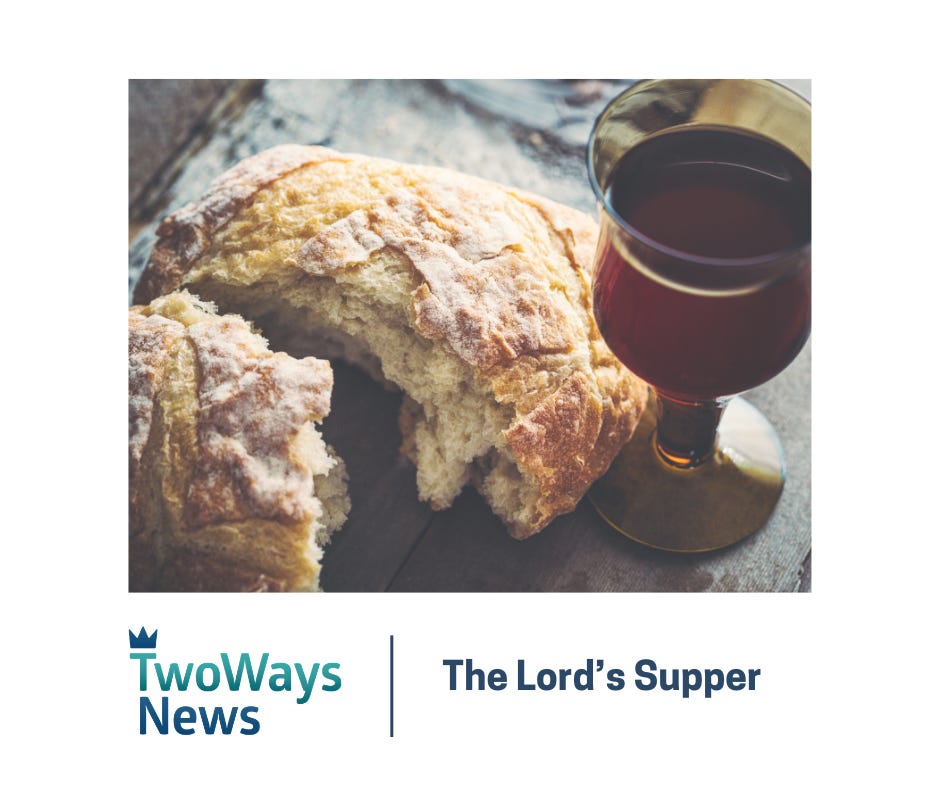
One of the longest standing debates amongst Christians is, strangely, about one of our strongest illustrations of unity. For the Lord’s Supper is meant to be an expression of our unity in the death of the Lord Jesus Christ as we proclaim his resurrection. Yet as long ago as 1 Corinthians was first written, we find Christians divided at this event to such an extent that Paul declared that what they did was not the Lord’s Supper.
So what is the Lord’s Supper about, and what were they doing that so disqualified them from celebrating it?
It is an interesting and defining passage on this important activity which is so central to church life.
Yours,
Phillip
Peter Jensen: 1 Corinthians 11:17–34
But in the following instructions I do not commend you, because when you come together it is not for the better but for the worse. For, in the first place, when you come together as a church, I hear that there are divisions among you. And I believe it in part, for there must be factions among you in order that those who are genuine among you may be recognised. When you come together, it is not the Lord’s supper that you eat. For in eating, each one goes ahead with his own meal. One goes hungry, another gets drunk. What! Do you not have houses to eat and drink in? Or do you despise the church of God and humiliate those who have nothing? What shall I say to you? Shall I commend you in this? No, I will not.
For I received from the Lord what I also delivered to you, that the Lord Jesus on the night when he was betrayed took bread, and when he had given thanks, he broke it, and said, “This is my body, which is for you. Do this in remembrance of me.” In the same way also he took the cup, after supper, saying, “This cup is the new covenant in my blood. Do this, as often as you drink it, in remembrance of me.” For as often as you eat this bread and drink the cup, you proclaim the Lord’s death until he comes.
Whoever, therefore, eats the bread or drinks the cup of the Lord in an unworthy manner will be guilty concerning the body and blood of the Lord. Let a person examine himself, then, and so eat of the bread and drink of the cup. For anyone who eats and drinks without discerning the body eats and drinks judgment on himself. That is why many of you are weak and ill, and some have died. But if we judged ourselves truly, we would not be judged. But when we are judged by the Lord, we are disciplined so that we may not be condemned along with the world.
So then, my brothers, when you come together to eat, wait for one another—if anyone is hungry, let him eat at home—so that when you come together it will not be for judgment. About the other things I will give directions when I come.
Phillip Jensen: This passage contrasts that of our previous episode. In 11:2, he commends the Corinthians for following the traditions that he taught them, but in 11:17, he speaks of condemning them for their behaviour.
Peter: This is on the subject of the Lord’s Supper. It goes by different names in different church traditions, but here it’s the Lord’s Supper. For us Australians, supper usually means a cup of coffee just before bed. Is that the meaning of the Lord’s Supper?
Phillip: It could be called ‘The Lord’s Meal.’ It couldn’t be ‘The Lord’s Passover’, because that would imply that the Passover is an ongoing thing, when the Lord’s Passover only happened once. Perhaps it could be ‘The Lord’s Dinner’? That’s a better word, because ‘dinner’ can refer to lunch or the evening meal. It’s a word that refers generally to a full meal.
Peter: Yes, and that’s what seems to be occurring here, because some people are eating a full meal whilst others seem to have nothing to eat. So it seems to be more than simply receiving a tiny scrap of bread and a sip of wine.
Phillip: That’s clearly the case, but it’s the context of church. I don’t go to church to eat, as I’m generally eating at home. Church is not the place for meals, but the Lord’s Supper is the assembly of God’s people to eat. Sometimes we do eat at our church, but we do it in the hall afterwards, not in the church building.
Peter: This passage, however, is quite special as it is the one passage where the Lord’s Supper is described to us.
Phillip: Yes, but the supper being in the church raises questions about the nature of the church and of what we call sacraments. It’s all intertwined with the subject of food and the purpose of eating meals rather than just grazing.
Peter: You’re perfectly right; we need to recognise the importance of meals in human experience. We could just eat on our own. We could be built in such a way that we could put food into our stomachs, like a motorcar, but that’s not how it is. A meal is a gathering of people, and it’s based on the idea of forgiveness and fellowship, because you gather with people that you can at least get on with. Christmas dinner is a very interesting example of all this. A lot of the time, the mother wants the whole family to be there at Christmas, but then there are stresses and strains in the family which are sometimes at their worst when you are sitting at the table, not talking to each other. Meals have that sense of sharing and fellowship. By the way, your reference to the idea that you eat a meal at church once a quarter is contrary to Asian cultures, where they don’t just have a dry biscuit after church; they have a meal.
Phillip: I’ve always liked being invited to Chinese churches to preach.
Peter: It’s because it’s not just the food; it’s the fellowship and the humanity of the occasion. You can see the importance of food in the ministry of Jesus. As Luke 15 tells us, Jesus ate with tax collectors and sinners. For our modern culture, this is like eating with those who operate drug cartels. This was sending a message which his opponents, the Pharisees, understood only too well. How could he eat with tax collectors and sinners? Jesus immediately went on to talk about repentance and forgiveness, as symbolised by the meal. The Passover, too, is a remembrance of the escape from Egypt. That concept of remembrance through meals turns up in other areas as well: after the Battle of Waterloo, the Duke of Wellington had a meal for his generals every year to remember the battle. There are plenty more instances of people using a meal as a remembrance of something, hence the importance of memory. That’s the very word that we’ve seen Jesus using.
Phillip: But when you remember the battle at the meal table a year later, does that mean you bring the battle back into the event?
Peter: I don’t think so. I believe it would be about having gratitude that we’re still here to share it together.
Another use of the word ‘meal’ in the Bible, of course, is when we see the great banquet at the end. Eternal life is described in these terms. So there is something special about the consumption of food around the same table, for at its essence is reconciliation, friendship and love for each other.
Phillip: It’s also about the celebration of something, be it a wedding or Christmas.
One of the powerful things about this passage is that Paul says, “It is not the Lord’s Supper that you eat.” The Corinthians think they’ve come to eat the Lord’s Supper, but that’s not what they’re doing. What is it that he’s speaking about here? It’s not our controversies. We’ve got to be careful not to read our controversies into 1 Corinthians, but to read their controversy as it applies to us. In the 9th century, there were two men, Radbertus and Ratramnus, who had a debate about the presence of the Lord in the Lord’s Supper, over whether the Lord was present in the bread or in the hearts of the people eating the bread. That kicked off hundreds of years of controversy. Both of them could quote early church fathers to prove their point, because previous generations hadn’t debated this subject. They just knew the Lord was present, that this was the Lord’s Supper. But how the Lord was present, whether he was present in the bread or in the believer, had not been discussed until that point.
So there are now views like transubstantiation, where the bread transforms into the physical, literal body of Jesus. There’s the idea of consubstantiation, which the Lutherans came up with. In this view, the bread is the focus of the body of Jesus, but the bread itself is not changed. Jesus is in, with, and by the bread. But then other reformers like Calvin and Zwingli were much more concerned about the heart of the believer. Calvin said that the Spirit is the way in which Jesus is present in the Lord’s Supper, because the Spirit is in the heart of the believer. That reformed position is the position of our prayer book.
Peter: Indeed. The founding fathers had their differences; Calvin and Zwingli disagreed with each other, but nevertheless, we Anglicans belong to that Reformed tradition. It’s indicated in the wonderful rubric within the prayer book, which was aimed at Luther, I believe. It’s called the Black Rubric, and it talks about the body of Christ.
Phillip: Calling it ‘The Black Rubric’ is strange, because the rubric refers to the bits written in red explaining what you should be doing. So the idea of a black rubric is a contradiction of sorts. However, this rubric was added later, and it was put in black. The Black Rubric occurs at the end of the Lord’s Supper.
It is hereby declared, That thereby no adoration is intended, or ought to be done, either unto the Sacramental Bread or Wine there bodily received, or unto any Corporal Presence of Christ’s natural Flesh and Blood. For the Sacramental Bread and Wine remain still in their very natural substances, and therefore may not be adored; (for that were Idolatry, to be abhorred of all faithful Christians;) and the natural Body and Blood of our Saviour Christ are in Heaven, and not here; it being against the truth of Christ’s natural Body to be at one time in more places than one.
This is anti-Lutheran, for Luther had a ubiquitous understanding of the body of Christ. That is, he wasn’t just in heaven; he was everywhere, and so he could be in the bread and the wine. But it’s absolutely explicit here that the presence of the Lord in the Lord’s Supper is not in the bread or the wine, otherwise you would carry it around, and you would bow to it. You would adore it, which people do within certain traditions.
Peter: There was then the Council of Trent, quoted in the modern Roman Catholic Catechism as well
That by the consecration of the bread and wine, there takes place a change of the whole substance of the bread into the substance of the body of Christ our Lord; and of the whole substance of the wine into the substance of his blood.
By the consecration the transubstantiation of the bread and wine into the Body and Blood of Christ is brought about. Under the consecrated species of bread and wine Christ himself, living and glorious, is present in a true, real, and substantial manner: his Body and his Blood, with his soul and his divinity (cf. Council of Trent: DS 1640; 1651).1
The Holy Catholic Church fittingly and properly calls this change ‘transubstantiation’. The Eucharistic presence of Christ begins at the moment of the consecration and endures as long as the Eucharistic species exist. That’s quite different from our tradition.
Phillip: It’s very different at this point, but we haven’t said what it is yet. So let’s discuss the meaning of the Supper according to 1 Corinthians 11:26, the proclamation of the Lord’s death until he comes. What is it that we are doing at the Lord’s Supper? If God is not turning the bread and wine into the physical body and blood of Jesus, what is the purpose? What is it that they weren’t doing in Corinth that disqualified them?
Peter: I’ve always been struck by 11:26, “For as often as you eat this bread and drink the cup, you proclaim the Lord’s death until he comes.” So the Lord’s Supper is a proclamation, an outward and visible sign of the gospel. It is a preaching of the heart of the gospel, which is the forgiveness of sins through the death of the Lord Jesus Christ. So to partake of his body and blood is not a matter of a physical partaking of the body and blood; rather, to eat by faith, you partake of the body and blood of Christ, as John 6 tells us. In any case, we are united with Christ by faith. Nonetheless, just as the preaching of the word is a special moment, we are reminded and called upon by the Lord’s Supper for faith. So it is like the preaching of the word. It has the same result, namely that you remember and that you receive, by faith, the body and blood of Christ symbolised by the bread and wine. I’ve never been able to see why people think it is the literal body and blood of Christ, given that when Christ said, “This is my body,” he clearly meant, “This represents my body.”
Phillip: He uses that kind of metaphoric language on other subjects. He says, “I am the good shepherd,” even though he was a carpenter. “I am the door,” he says, but he certainly wasn’t wooden. To say that you are something which you are manifestly not is to say, “This door represents me. I am functioning as the door.” Or, “I am functioning as the good shepherd.” So saying, “This is my body,” can hardly mean that he is taking part of his body off himself.
Peter: No, and if it is the preaching of the cross, proclaiming the death of Christ until he comes, then in its very heart is forgiveness. That is, this wonderful gift of forgiveness we have received from God in Christ. Then, as the Lord makes perfectly clear not least in the Lord’s Prayer, if you are forgiven, you must forgive. In other words, the whole business of being united with Christ by faith, symbolised in the bread and the wine, that whole business is intended to transform your life—and in particular, to make you a person who loves others, especially your brothers and sisters in the Lord. So the whole idea is that if it’s a proclamation of the death of Jesus, it must be a means of uniting with one another, as a meal should.
Phillip: We unite in the forgiveness that Jesus Christ has won for us. It’s not uniting with each other in the memory of winning the battle of Waterloo, or because we’ve all got the same grandparents. It’s uniting with each other because with this meal we are remembering and proclaiming the basis of our fellowship, being that we are washed clean by the blood of the Lord Jesus Christ.
Peter: It wasn’t intended to be an occasion where you could skip dinner at home to feed yourself, while other people would attend and have nothing. To do what they were doing was to despise the church of God.
Phillip: It was a lack of love. But it’s called a love feast, and rightly so, because you are demonstrating your love for one another, and the Christian love for one another stems from God’s love for us in the death of his Son. As Jesus says during the Last Supper, John 13:35, “By this all people will know that you are my disciples, if you have love for one another.” So if you’re treating each other unlovingly—for instance, when one is eating and drinking whilst the other is thirsty and hungry—at the love feast of all places, it means that you are not celebrating the Lord’s Supper. That is reflected in our prayer book, which says that we need to have, within our congregational life, love for one another if we are to dare to come in the name of the Lord Jesus to his table.
Peter: This must be what Paul means when he says, “You don’t discern the body.”
It’s interesting to hear about the Council of Trent, particularly regarding the emphasis on the moment of consecration, because that’s when the bread and the wine become the body and blood of Christ in the Roman Catholic tradition. But in our prayer book, I think more correctly, the emphasis is on eating and drinking together. It’s about unity. Indeed, you’re not supposed to have the Lord’s Supper on your own. There ought to be at least 2 or 3 people present, according to the prayer book, unless a person is very sick, I believe.
Phillip: There’s a great warning in our prayer book services, which, I’m sorry to say, we rarely read, about being in love and fellowship with your neighbour. If you’re not in love and fellowship, do not think to eat and drink, for it is an expression of the forgiven fellowship with your neighbour.
Peter: We do need the ‘communion’ service, as it’s called because it is the Latin version of the word ‘fellowship’. It is a fellowship meal. We need it because it is about our union with Christ, but that union with Christ entails our union with others. That service in the Book of Common Prayer is a work of genius. It unfolds the gospel from sin to salvation, and it leads to this—then there’s this warning, based on 1 Corinthians 11, that we ought to be in fellowship with each other.
Phillip: We are talking about the 1662 prayer book, correct?
Peter: Yes, that’s the one I was brought up on.
Phillip: As opposed to modern prayer books of the 20th and 21st centuries.
Peter: They have their ups and downs, but that one is the one that we appeal to. I remember hearing a story once of two sisters who were out of sorts with each other for many years, but they went to the same church. Every Sunday they would sit in different parts of the church and receive the Lord’s Supper, but they never spoke to each other in or out of church, and they acted as people who hated each other.
Phillip: That’s not the Lord’s Supper. I’m sure they would have gone home thinking they had been to the Lord’s Supper, because physically, they were at a church conducting it, but spiritually they weren’t celebrating the Lord’s Supper at all.
Catechism of the Catholic Church (2nd ed.) (1997)
https://www.scborromeo.org/ccc/para/1413.htm
Scripture quotations are from The ESV® Bible (The Holy Bible, English Standard Version®), copyright © 2001 by Crossway, a publishing ministry of Good News Publishers. Used by permission. All rights reserved.
Links & Recommendations
For more on this topic, check out this talk called The Meal That Unites.
Freely available, supported by generosity.
If you enjoy Two Ways News, why not lend us a hand? Consider joining our Supporters Club—friends who make it possible for us to keep producing this article/podcast.
To join the Supporters Club, follow the link below to the ‘subscribe’ page. You’ll see that there’s:
a number of ‘paid options’. To join the Supporters Club take out one of the paid ‘subscription plans’ and know we are deeply grateful for your support!
also the free option (on the far right hand side)