Dear friends,
We do appreciate comments and feedback, and even questions from our many subscribers. Sadly, we haven’t got the time or resources to be able to answer each question; however, two of the comments that came in to us on the Acts 17 passage we thought would be very helpful to air in this episode of Two Ways News, before we look at the two wisdoms contrasted in 1 Corinthians chapter 2.
Yours,
Phillip
Phillip Jensen: Today, we will speak on 1 Corinthians chapter 2, a great passage about the two wisdoms. But before we start, we must go back to some previous episodes. I would like to take this opportunity to thank those who have written to us, and to respond to some of the questions and comments that have come through. We don’t reply to every comment, but we do read them all and take careful note of them. But there are two pieces of feedback on Acts 17 that we should pick up on.
The first piece of feedback came from our dear friend Barry, who said that he enjoyed hearing about ‘the unknown god’ regarding Acts 17:23 . However, he informed us that the ancient Greeks didn’t have a concept of religion, according to Edwin Judge, since for most people, all of life was what we would term ‘religious’. A more accurate translation of what Paul said regarding the Athenians’ understanding of spirituality might be something like, “I perceive you are very careful in your piety.” For the Greeks were so afraid of offending any gods that they built altars to unknown gods, one of which caught Paul’s eye.
Peter Jensen: Personally, I agree with this viewpoint, particularly if it’s held by Edwin Judge, the great ancient historian to whom we owe so much.
Phillip: Religion is a funny thing. I have used the language of today in my referral to the ancient Greeks as being ‘religious’. We have a general understanding of what is meant by ‘religion’—temples, sacrifices, priests, holy buildings—but it is important to acknowledge this point, because the word ‘religion’ is something that has developed over time. This word, as it is used today, comes from the 19th century, when the Raj in India had to differentiate followers of Christianity, Hinduism and Buddhism. However, the word became especially useful in Western society when Holyoake and others invented the term ‘secularism’. At that point, religion became what was not secular, and that then defined how we refer to religion today. Our 21st-century word ‘religion’ is frankly unhelpful, because it implies that anything ‘secular’ is the norm, and anything other than a secularist worldview is a religious worldview, which is oftentimes deemed ‘irrational’ and ‘superstitious’. When we refer to the scriptures, that division between secularism and religion does not appear; therefore, we need to be careful not to impose it onto the Bible when we read it. So thank you Barry for raising this point. We need to express clearly that ‘secularism’ is atheism, a modern invention, which then created ‘religion’ as a modern invention.
Peter: It’s worth noting too that the word ‘secular’ in itself doesn’t mean ‘without religion’. It means ‘things of this world’. There are secular priests, for example.
Phillip: The Catholic Church has secular priests who are “out in the world” as opposed to being monastic.
Peter: Indeed. It’s also important because here in the state of New South Wales we have what is called ‘secular education’, but that doesn’t mean it is anti-religious or even unfair.
Phillip: No; it just means education about the world.
Peter: Now onto a point raised by Sharon, which is again very helpful indeed. Sharon recently visited Greece, during which the tour guide drew her attention to the fact that there is an existing extra-biblical ancient source explaining the origin of the altar to the unknown god. She refers to Diogenes’ ‘Lives of Eminent Philosophers’, in which he recounts the philosopher Epimendides setting up several altars to the unknown gods near the Areopagus at around 600 BC. This certainly corroborates the evidence in Acts 17, although it seems to suggest that the altars were for several unknown gods rather than one. Regardless, this is particularly relevant because Paul also quotes from Epimenides later in the same speech. I might add that this point is made in the commentaries by David Peterson and F.F. Bruce, for those who are interested. But we would like to thank Sharon for this very enlightening and helpful comment.
Phillip: Indeed. The question is, though, do I believe it now because the history books refer to it, or do I believe it because the Bible says it?
Peter: That’s an important question because there’s been much dispute around this topic. For example, there was previously no reference to King David outside the Bible, leading to skepticism over whether he existed. However, a recent archeological find has revealed that David did exist. But we didn’t need that archeological find to know he existed; we have the Bible.
Phillip: A similar thing happened with Pontius Pilate. In the 1960s, archaeologists discovered a stone with his name and title. But I believed in Pontius Pilate before then.
Peter: What we need to recognise is that even the greatest historians only know about a small fraction of what happened in the past. If I could spend a week in Israel at the time that Jesus was there, how much more would I know about what life was like?
Phillip: The old saying goes, “Absence of evidence is not evidence of absence.” It’s important to remember this when people say that because there is no evidence for something other than the Bible. The Bible is evidence.
However, we must come to today’s passage in 1 Corinthians 2 about the two wisdoms that we deal with. Part of the contemporary attack on Christianity is about the notion that it’s anti-intellectual. Indeed, some Christians are profoundly distrustful of learning to the point that they attack modern science, modern education, and other areas of the wisdom of this world. But is Paul’s attack on wisdom in line with this anti-intellectualism?
Peter: Not if we see in the second half of the chapter the embrace of the wisdom he’s talking about. There are two wisdoms: that of the sinful world and that of God.
Phillip: 1 Corinthians 2:6–16
Yet among the mature we do impart wisdom, although it is not a wisdom of this age or of the rulers of this age, who are doomed to pass away. But we impart a secret and hidden wisdom of God, which God decreed before the ages for our glory. None of the rulers of this age understood this, for if they had, they would not have crucified the Lord of glory. But, as it is written,
“What no eye has seen, nor ear heard,
nor the heart of man imagined,
what God has prepared for those who love him”—
these things God has revealed to us through the Spirit. For the Spirit searches everything, even the depths of God. For who knows a person’s thoughts except the spirit of that person, which is in him? So also no one comprehends the thoughts of God except the Spirit of God. Now we have received not the spirit of the world, but the Spirit who is from God, that we might understand the things freely given us by God. And we impart this in words not taught by human wisdom but taught by the Spirit, interpreting spiritual truths to those who are spiritual.
The natural person does not accept the things of the Spirit of God, for they are folly to him, and he is not able to understand them because they are spiritually discerned. The spiritual person judges all things, but is himself to be judged by no one. “For who has understood the mind of the Lord so as to instruct him?” But we have the mind of Christ.
Peter: So the wisdom of God is not opposed to great human thought. Paul quotes the philosophers, thereby demonstrating that there are wonderful things that occur through human thought; that’s the way God created us. But the wisdom of God does differ from that of sinful human culture in thinking about fundamental issues. How do we experience this? What do you think is the best way of describing it?
Phillip: Take the Tower of Babel for example. There was great wisdom and great foolishness in what the people were doing. For they used technology. They understood how to make bricks without stone, which was impressive. Indeed, God, when he views what they’ve done, says that they will be able to do anything. The wisdom demonstrated here is described as “the wisdom of this age” and “the rulers of this world”. Every age has its rulers who impose their wisdom, and whose wisdom passes away with them. From the late 19th century through to the late 20th century, the wisdom of eugenics was imposed upon our societies. In the hands of Adolf Hitler, of course, it did incredible damage to the whole world, but it didn’t just show up in Germany. It was here in Sydney and Melbourne, too. It was this way of thinking that gave rise to a whole host of terrible social problems, such as the Stolen Generation amongst the Indigenous people.
But of course, these rulers didn’t understand God’s hidden wisdom. Now, the rulers that Paul is talking about in Corinthians demonstrated their wisdom in their execution of the Lord of Gory. Here were men and women, face to face with the Prince of Life, and they killed him. But that was God’s hidden plan: that he who was the ruler of the world would become a man rejected by humans, in order that he may pay the price for our sinfulness.
Peter: Indeed. Human wisdom can accomplish great and terrible things. We are surrounded by advances in medicine, but we have also created atomic power. But the Apostle speaks here of fundamental wisdom. Wisdom is defined relationally, as being the true knowledge of God: the fundamental wisdom without which all other wisdom is lost. It’s a wisdom which is secret and hidden. The wisdom of God is God’s determination for our glory. It is hidden, but it is eternal in God. Furthermore, it is the wisdom which rules the world, and which we need to discover. But we can’t discover it because we are sinful people. So how does that relate to the way in which human beings, as God’s image-bearers, achieve so much in the world?
Phillip: I am happy with that way of putting it, and that God has a plan for our glory. What lies ahead of us? The world doesn’t know. But God tells us what lies ahead of us: our glory, that he planned to bring about through the death and resurrection of his son. That was a great secret. The wisdom we have is built on a lie. The scientific revolution has been a wonderful thing, but of course, neither rationalism nor the scientific revolution of empiricism can ever tell me what’s on your mind and what’s in your heart. If you can’t tell me what’s on a human’s mind or heart, you certainly can’t tell me what’s in God’s mind or heart.
Peter: Do you accept that the true wisdom that we need, the fundamental wisdom, is relational?
Phillip: It is, because it’s God’s wisdom of revelation: not of rationalism or empiricism, but of knowing the mind of God.
Peter: It’s not just general revelation, but the revelation of a person.
Phillip: It’s knowing the mind of a personal God as opposed to knowing the functioning of an impersonal force. Physicists may understand the functioning of a force, but no one will understand the mind of a personal God. But the difference is very great. What we have from the personal God is his plans for us, for the universe that he’s made, but also for the future. Plans which involved hiding his wisdom so that the rulers of this world could kill his son. In Acts 2:23, Peter says, “This Jesus, delivered up according to the definite plan and foreknowledge of God, you crucified and killed by the hands of lawless men.”
There’s the great plan of God: our glory through the resurrection of the Lord Jesus Christ through his death and resurrection, which the rulers of this world did not understand, otherwise they would not have put into effect the plan of God. But the mind of God is very personal, for he’s a personal God. Therefore, the way in which we know him is by the revelation of the Spirit.
Peter: I like the way you have put things, particularly in comparing God’s wisdom with ourselves. It’s very difficult to know another person. You can tell certain things about them, but having a deeper understanding of them requires a disclosure from them. This is what we call ‘revelation’: God’s disclosure of himself without which we could not know him. This is connected with the doctrine of the Holy Spirit.
Phillip: That is what 1 Corinthians 2:6-16 is about.
Peter: We learn a great deal about the work of the Holy Spirit in that passage, because the Spirit knows what humans cannot know. The Spirit knows the mind of God, because he is God. So in this new age of the Spirit following the resurrection of Jesus, it means that the Holy Spirit reveals what the spirit of this world has never understood. Even given the remarkable things that human beings do, even the most brainy person cannot understand the things of God unless it is revealed to them. That is because of human sin, particularly.
But we do know God. It comes to us through the Spirit-inspired words of the gospel, found in the Bible, and it’s received by us through the illumination of the Spirit.
Phillip: But it’s more than just sinfulness. It’s also that as creatures, we cannot know the mind of the Creator without revelation. I can’t know your mind without you speaking to me. You are human, you are personal, therefore I cannot know what you’re thinking.
Peter: So whenever God discloses himself, he does it in a way that he doesn’t have to, but he chooses to out of his grace. This is wonderful.
Phillip: It’s marvellous. But there are two sides to this. One side is the public revelation of himself through Jesus’ death and resurrection. The other is the opening of our minds to understand what is being said.
That illumination is the work of the Spirit. For here is the great divide between the elect and the non-elect by their reception of the gospel. For the natural person hears the gospel and calls it folly, whereas the person enlightened by the Spirit hears the gospel and sees it as the truth by which to live. He hears the wisdom of God rather than the folly of the preacher. Then the spiritual person judges all things from this worldview of wisdom that comes from God, which is so contrasted to the worldview that comes from the rulers of this age. The key to evangelism is this enlightening work of the Spirit, which in turn gives us the key to our wisdom.
Peter: Phillip, you have the gifts of an evangelist. So what difference does it make in your evangelistic work to know what 1 Corinthians 2 teaches us?
Phillip: It makes a lot of difference, in terms of the salvation of people and how the gospel goes forth, but also in the activity of day-by-day preaching the gospel. Firstly, it makes you prayerful, because it’s the work of the spirit that makes the difference in people’s hearts, rather than the quality of your presentation or anything like that. It drives you to your knees that God would open the hearts and minds of people. That gives you humility, because when people are converted, you know that it’s not because of your own gifts.
I remember giving the same exact talk at 2 separate university missions. At one university, hardly anybody was converted, but at the second, many people were converted. They were the same talks given by the same preacher. The difference was the great plan and the purposes of God: that is, the work of the Holy Spirit in the opening of minds. So when people get converted, I’ve got no grounds for calling myself a great preacher. In fact, if they were converted because I was a great preacher, I suspect they weren’t truly converted.
You must have humility as an evangelist, but this will also give you confidence, because there is nothing so simple as the gospel that, under the Spirit, can convert the greatest and the least of minds. So I know God has his people who he’s calling through the gospel. My job is to call; he will bring that message. It’s this hidden message. 1 Peter 1 tells us that the prophets of old didn’t know what they were preaching. They preached faithfully, but the sufferings and the glories of Christ were hidden from them. Again, in 1 Thessalonians, Paul knew that the Thessalonians were chosen because they responded positively to the gospel. Romans 8:5–8 says
For those who live according to the flesh set their minds on the things of the flesh, but those who live according to the Spirit set their minds on the things of the Spirit. For to set the mind on the flesh is death, but to set the mind on the Spirit is life and peace. For the mind that is set on the flesh is hostile to God, for it does not submit to God’s law; indeed, it cannot. Those who are in the flesh cannot please God.
Plain and simple is our message. But the power of God is in the message to transform, to enlighten the hearts and minds of people, and the fear of the Lord is the beginning of that wisdom that enables people to see everything differently.
Peter: There are 2 points I would like to add. The first is that even the elect may resist the gospel to begin with, but then comes the moment when they accept it. So the fact that people may reject the gospel now doesn’t necessarily mean that they won’t accept it in the future. That means you must persist in speaking.
The second point is that the 1 Thessalonians passage you refer to illustrates not only God’s great work and the elect people, but also the way in which he uses us to do his great work. It’s very kind of him to do so. The passage also talks about the way that the Thessalonians responded. It’s as if God works through human responses and human obedience, even though he doesn’t need to.
Phillip has been talking as an evangelist, and I want to conclude by mentioning that I teach doctrine, and 1 Corinthians 2:6-16 is great for christology, the teaching about Jesus Christ. It is also great for teaching the grace of God, for it tells us that our salvation depends upon him. Additionally, it is wonderful in teaching anthropology: our doctrine of humanity, our understanding of sin, and the inability of human beings to understand the fundamental truth of the gospel. Furthermore, it informs us about pneumatology, the doctrine of the Holy Spirit.
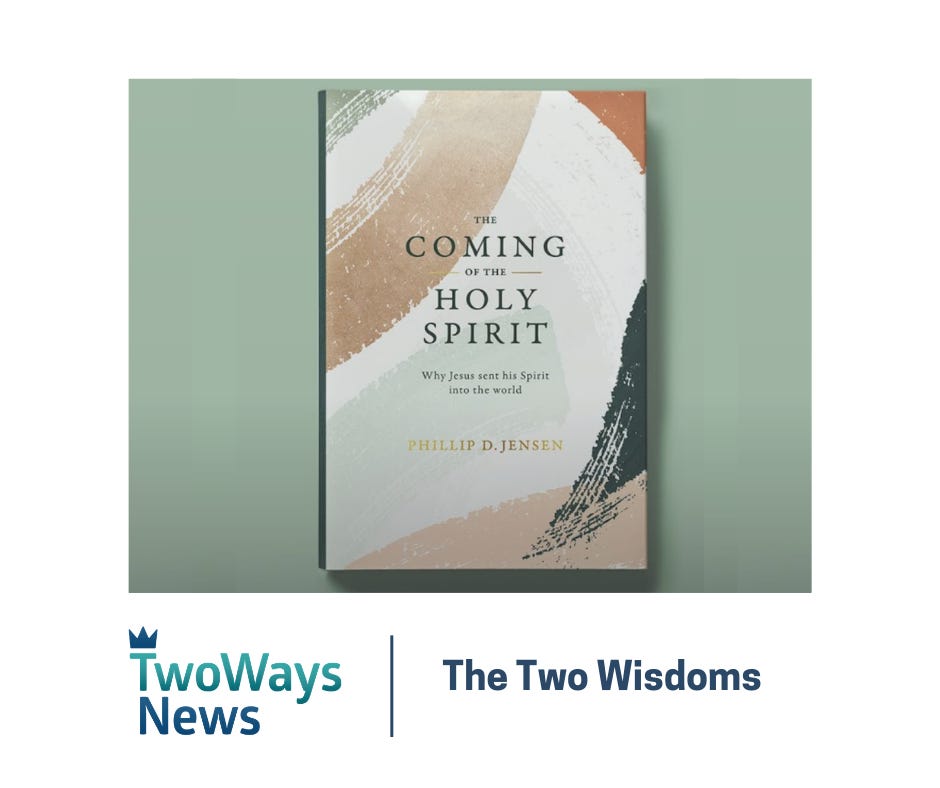
Apparently Phillip Jensen has also written a book on pneumatology, The Coming of the Holy Spirit,1 which is so helpfully written. About half of it is taken up with appendices on different subjects to do with the Holy Spirit, but the first half provides an exposition of the motion of the Holy Spirit.
Phillip D. Jensen, The Coming of the Holy Spirit, 2022 (Matthias Media)
Scripture quotations are from The ESV® Bible (The Holy Bible, English Standard Version®), copyright © 2001 by Crossway, a publishing ministry of Good News Publishers. Used by permission. All rights reserved.
Links & Recommendations
For more on this topic, check out this talk from St Andrews Cathedral City Night Church called The Secret Wisdom of God.
Freely available, supported by generosity.
If you enjoy Two Ways News, why not lend us a hand? Consider joining our Supporters Club—friends who make it possible for us to keep producing this article/podcast.
To join the Supporters Club, follow the link below to the ‘subscribe’ page. You’ll see that there’s:
a number of ‘paid options’. To join the Supporters Club take out one of the paid ‘subscription plans’ and know we are deeply grateful for your support!
also the free option (on the far right hand side)