Dear friends,
As we continue in our studies on 1 Corinthians, we learn a lot about Paul the evangelist. This helps us in understanding evangelism ourselves and our evangelistic efforts.
However, before we get there, we need to backtrack a little to our episode about Bondi and antisemitism to clarify some of the things that we said. I hope you find these clarifications helpful, though the subject of evangelism in 1 Corinthians chapter 2 is more important.
Yours,
Phillip
Phillip Jensen: Following our recent episode Bondi and Antisemitism, we need to make some qualifications about the things we discussed, for we are worried that some of our points were not expressed as well as we intended.
Firstly, I think we gave the impression that we thought antisemitism was a new phenomenon that did not exist in the 1950s. That isn’t the case, and the history of Sydney’s golf clubs, for example, indicates just that. At that time, Jews weren’t allowed to join several of the leading golf clubs of Sydney, which led to them creating their own club, Monash Country Club up at Ingleside. In one sense, this was simply part of the tribalism of the early 20th century in Sydney. The Roman Catholics were also excluded from golf clubs and, like the Jews, they founded St Michael’s at Little Bay. This aspect of history reminds us that there’s no such thing as a golden age of sinlessness. However, we must not generalise tribalism to such an extent as to fail to notice that antisemitism was a particularly nasty feature of it, and had its own distinctive characteristics. As a matter of fact, the Catholics and the Protestants got on with each other better than the way either of them treated the Jews. In fact, Christianity has had a very sad history of antisemitism throughout the centuries.
Yet the antisemitism of recent years is more explicit, more hateful, and more potentially violent than it was in the 1950s. I don’t recall, either historically or from our experience, that back then there was any likelihood of people shooting or bombing Jewish people. The synagogues in our suburb then didn’t have guards standing outside them, whereas the synagogues in my suburb now are surrounded with guards and police. Antisemitism has become much more explicit. There are all kinds of reasons why: firstly, there has been a re-emergence of the Nazi party, which is almost unimaginable to people who grew up in the 1950s, after our nation had fought against them. Another contributing factor is that we now have an Islamic community of great size in Australia, which we didn’t have in previous generations, creating a division in our society that we didn’t have previously. Thirdly, there’s been a shift towards the ideology of identity politics, of oppressors and oppressed tribes. There is also the community response to the war in Gaza, and especially to the way in which Israel prosecutes that war. And of course, there is the historical ignorance of our society. We don’t teach about the Holocaust; we don’t teach about the history of the establishment of the State of Israel; we don’t teach the history of the Bible; we don’t teach the history of the Middle East. Thus, there is a significant amount of ignorance in our community about these matters.
One of the factors that I believe contributes to our ignorance is the secularists, who often run our education and our government, because they fail to understand or respect religious motivations. They are against religions in general, and they lump them all in one category called ‘faith communities’, because they don’t understand the differences and the motivations involved. This can be seen in the way the government has tried to equate antisemitism with Islamophobia, even though they cannot really be equated. This has resulted in our government being unwilling to protect the Jews. I noticed that the Prime Minister, in making a public apology, said that “we could not” defend the Jewish people, rather than “we did not”, implying that it was somehow beyond our capacity to do so. These many contributing factors have given rise to why we are going to have a Royal Commission into antisemitism. But as we wish to reiterate, antisemitism has been running for over a century within Sydney as a community.
That brings us to the second qualification that we would like to make, which is about the usage of certain terms. How do you understand terms such as ‘antisemitism’, ‘Zionism’, and ‘the Israeli government’? How do these 3 ideas interact?
Peter Jensen: Antisemitism has had an extremely long history, whereas Zionism, being the belief in the right of the Jews to have the modern state of Israel, only goes back to the post-Second World War period. People, of course, have very strong opinions about this. Those in favour support sending the Jews back to their homeland, an event which occurred during that period of time. However, this action led to negative consequences. So Zionism is a political matter. But it’s worth saying that you can be against the idea that there should be a state of Israel whilst not being antisemitic; it depends on your reasons as to why you hold that opinion. Likewise, Israel’s government makes political, economic and military decisions which we may or may not agree with. If, for example, you disagree with the way in which they are conducting the present war, it doesn’t automatically mean you are antisemitic.
Phillip: There were people who objected to the ways in which the allies prosecuted the Second World War, after all, including those who objected to the dropping of the atom bombs. How a government conducts a war is a political decision that you can agree or disagree with.
Peter: I have been reading a book about the conduct of war, where the author talks about how the British prosecuted the war in Europe with carpet bombing and other such things. There were many people who objected to these actions, and some of the stories that this man brings up in his book highlight that war is a horrible and ugly thing. I hope that I’ve been clear in saying that antisemitism is wrong, but the issue of Zionism and the activities of the Israeli government are matters for discussion, and differences of opinion can arise about those topics without those opinions necessarily being antisemitic.
Phillip: But there is an overlap, for the antisemitic person will be anti-Zionist and will be against the Israeli government’s decisions.
Peter: I fear so. Furthermore, given the fiery nature of this discussion, it is interesting to see how much the war in Gaza has been covered within Western media, yet there are other terrible things going on elsewhere that hardly get a mention. What are the reasons for this?
Phillip: You could argue that the West’s involvement is part of it too, but you raise a good point: why don’t we hear about Sudan? There are many Sudanese people in Australia, yet we don’t hear much about the horrendous things that are happening there. However, that is a discussion for another day. For now, we will move on to 1 Corinthians 2:1-5, which is on the subject of evangelism.
When Paul came to evangelise to the Corinthians, he taught us how to fulfill the Lord’s commands to go into all the world.
Peter: Inherent in what he says here, and even throughout the whole chapter, are key insights into how God works in bringing people to himself. Fundamentally, what we see here is yet another example of the way in which God’s grace and love for the undeserving is at work, how salvation is from grace, and how we cannot praise ourselves for choosing God.
Phillip: Yes, although as I indicated, the passage is about evangelism. We have been given the task of evangelism, which is about what we say and how we say it. What we say is the message of the cross: a message that is not attractive to the world, neither then nor today. How we talk about the message of the cross is described in 1 Corinthians 2, for Paul mentions in verse 3 that he proclaimed it “in weakness and in fear and much trembling.” Many people, when they come to evangelise, have a certain fear and trembling just like the Apostle Paul did.
Peter: To read from 1 Corinthians 2:1-5,
And I, when I came to you, brothers, did not come proclaiming to you the testimony of God with lofty speech or wisdom. For I decided to know nothing among you except Jesus Christ and him crucified. And I was with you in weakness and in fear and much trembling, and my speech and my message were not in plausible words of wisdom, but in demonstration of the Spirit and of power, so that your faith might not rest in the wisdom of men but in the power of God.
The great Apostle Paul, the evangelist who stood up against authorities that were threatening to kill him, reveals here his own weakness and fear. I find this so encouraging, because I personally find evangelism very hard, especially one-to-one evangelism, and particularly amongst people that I know, because of my own fear. It’s encouraging, then, to see Paul admit this.
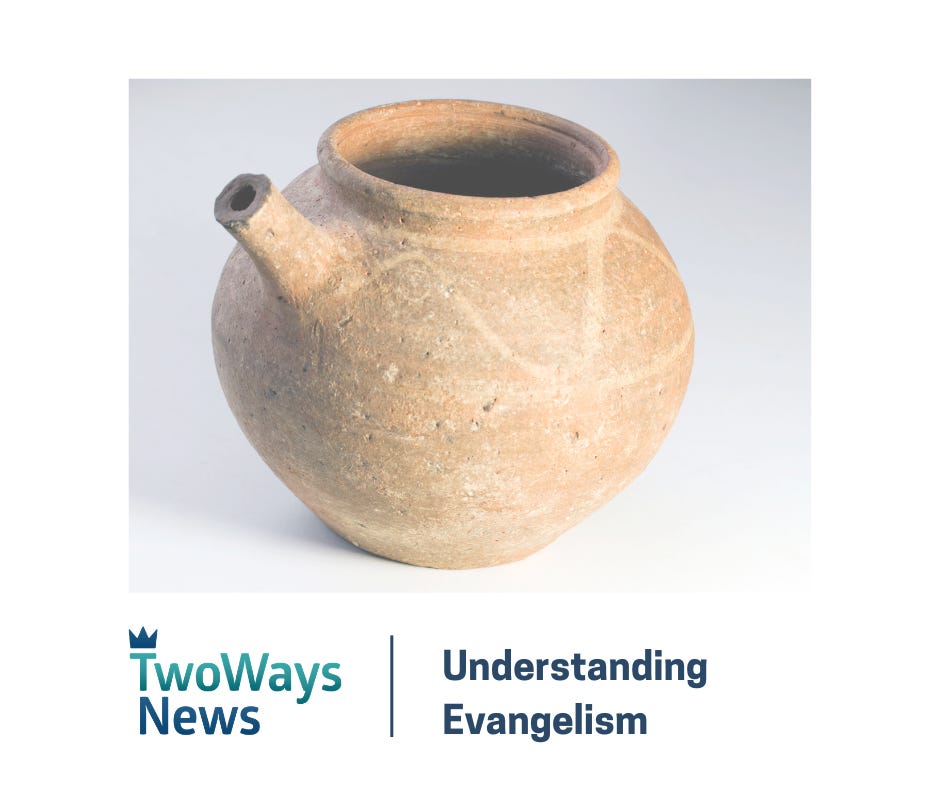
Phillip: Indeed, because within the New Testament, speaking the gospel boldly is one of the characteristics of evangelism. In Ephesians 5, Paul asks for prayer that he might be bold enough to speak as he ought to speak. It’s part of the fact that we are, essentially, clay vessels. What matters is not the appearance of the vessel; rather, it is that we contain the gospel, the power of God. It is important that we understand Paul’s teaching here in terms of ourselves. Like you said, it’s encouraging, because we also fear. But it’s also about the nature of evangelism, that it isn’t about being a great orator. What is more important is the humility of the message of the cross.
The cross assures us that the way of salvation is not by conquest, but by sacrifice and service in the Lord Jesus Christ. Having been saved by his sacrifice, we do not preach the gospel by overwhelming people. We have a message, but the message is an invitation to accept the sacrifice of our Lord and Saviour. Paul doesn’t come proclaiming the testimony of God using lofty language; he is not on his high horse speaking down to people. He deliberately proclaims the gospel by highlighting the humiliation of Jesus, and hence the humility of the cross. Paul does not portray himself as being the great man in Corinth. He’s the humble visitor in Corinth, building tents for a living.
Peter: As a doctrine teacher, I often turn to 1 Corinthians 2 in teaching the doctrine and the work of the Holy Spirit. The Apostle Paul tells us here, as you say, that his speech was not in plausible words of wisdom. He is not like someone trying to sell a product as in our day. He attributes his success simply to the work of the Holy Spirit in opening people’s eyes, despite the fact that he speaks to them in a very plain way. The Holy Spirit has done this. Once again, we are reminded of God’s grace in bringing people to himself. It’s God’s work.
Phillip: It is, because he describes the message as foolishness. Evangelism is about speaking, talking, proclaiming, telling. It seems strange, the idea of aiming to convert the world by simply telling people things. It’s not in doing miracles, in signs and wonders, or even through clever arguments and rhetorical tricks, but in opening hearts and minds to believe. But that’s the work of the Spirit who comes with our speaking. Because as we speak the Word of God, so the Spirit works in the hearts of the recipients. When Paul describes his preaching in 1 Thessalonians 1:4-5, he says
We know, brothers loved by God, that he has chosen you because our gospel came to you not only in word, but also in power and in the Holy Spirit and with full conviction.
As the Holy Spirit comes upon God’s people, they are fully convinced of the words that are being spoken in 1 Corinthians 2. That is because the purpose of evangelism is that our faith may rest on the power of God, not on the wisdom of man. When a very clever person evangelises with very clever arguments, the temptation is to put our faith in the person. C.S. Lewis was indeed a very clever man who used very clever arguments, but I would rather rely upon Jesus than C.S. Lewis to be saved. In fact, I’m sure C.S. Lewis would prefer that too. Wonderful miracle workers point to the messenger, and so our faith is in the cross of Christ, which is the purpose of God.
Peter: One of the best books that I read as a teenager was Dr. Packer’s Evangelism and the Sovereignty of God1 which I still recommend because it reminds us of some of these points. Returning to today’s topic, however, what do you think is the lesson about evangelism for us in 1 Corinthians 2?
Phillip: There are many things to take from this, really. Evangelism is about simply and plainly telling God’s truth. That’s why any Christian can be involved. If you can talk at all, you can tell people Christ is Lord.
Peter: But let me ask you a question. Paul says here that his message about the crucified saviour was regarded as ridiculous, and so it was. But 2,000 years later, the cross is something else entirely: it is everywhere. Is our message ridiculous to the Western world in which we live?
Phillip: It is, but it’s ridiculous for 2 reasons. The first is that people don’t understand it, but the second is that people do understand it. When you say that Jesus died, they say, ‘Yes, Jesus died for our sins’, because that’s the standard Sunday School answer that we were taught as children. But people have no understanding of what sin is or how Jesus dying for sins could make any difference. In our gospel summary Two Ways to Live2, we highlight 3 great doctrines that are essential to have as background information to understand the cross and the resurrection. If you don’t understand the creation, sin and judgement, Jesus’ death and resurrection don’t make sense.
Peter: So why does Paul say that he preaches Christ crucified?
Phillip: Because that is the one message that makes sense of the 3 doctrines of creation, sin, and the judgement that is to come. But without that background, you can’t make sense of the cross. In some ways, the connection between the Old and the New Testament is what we’re talking about. But it’s more than that: when people do understand the cross, they think it’s foolish because that message surely cannot bring about the change of the world, even though historically it’s quite manifest that it has. Paul writes later, in 1 Corinthians 15:3–4
For I delivered to you as of first importance what I also received: that Christ died for our sins in accordance with the Scriptures, that he was buried, that he was raised on the third day in accordance with the Scriptures
The phrase, ‘in accordance with the Scriptures’ appears twice, because without the Scriptures, you won’t understand either the death or the resurrection of Jesus. But this has to do with understanding, not apologetics. I'm afraid that people confuse apologetics and evangelism.
Peter: To return to the observation I made before about myself and doctrine, evangelism is the work of God the Holy Spirit.
Phillip: Absolutely, and to leave that out is a great mistake.
Peter: Indeed. Evangelism does not rely on human wisdom, but is the work of God by his spirit in the heart of unbelievers. One of my favourite passages is 2 Corinthians 4:1-6
Therefore, having this ministry by the mercy of God, we do not lose heart. But we have renounced disgraceful, underhanded ways. We refuse to practice cunning or to tamper with God’s word, but by the open statement of the truth we would commend ourselves to everyone’s conscience in the sight of God. And even if our gospel is veiled, it is veiled to those who are perishing. In their case the god of this world has blinded the minds of the unbelievers, to keep them from seeing the light of the gospel of the glory of Christ, who is the image of God. For what we proclaim is not ourselves, but Jesus Christ as Lord, with ourselves as your servants for Jesus’ sake. For God, who said, “Let light shine out of darkness,” has shone in our hearts to give the light of the knowledge of the glory of God in the face of Jesus Christ.
This passage refers to unbelievers as being ‘blind’, unable to see the light of the gospel. It refers to Paul as preaching the gospel, summarised aptly as “Jesus Christ as Lord”. But then, to summarise verse 6, the light is switched on and we see the face of Jesus Christ in all his glory. The switching on of the light is God’s work by his Holy Spirit. So the essence of evangelism is certainly about preaching the message to people who cannot believe. Then those whom God has chosen for that moment believe because he has turned the light on.
Phillip: That’s how we know the Thessalonians had been chosen, because of the way they responded. One of my favorite passages is 1 Thessalonians 2:13
And we also thank God constantly for this, that when you received the word of God, which you heard from us, you accepted it not as the word of men but as what it really is, the word of God, which is at work in you believers.
The Holy Spirit does the great work of evangelism through human messengers, by this great divine message of the cross, in the hearts and minds of hearers, as he brings them to new birth. The evangelist in this whole system is the Holy Spirit, and we are the microphone, the vessel which contains the powerful treasure of the gospel.
Peter: To conclude, evangelism is God’s work through his people, and therefore, all of us are evangelists who should take the opportunity to share the gospel, trusting in the Lord that if he pleases, he will open the eyes and hearts of the people we’re speaking to. But are there not people who are gifted as evangelists?
Phillip: There are, because we know Philip is called an evangelist in the book of Acts. Ephesians 4 also speaks about the gifts of the Lord Jesus Christ, which include the evangelists alongside the apostles and prophets. Additionally, Timothy is told to do the work of an evangelist. Thus, there are people who have a particular giftedness in evangelism.
Peter: How do you account for that?
Phillip: God in his kindness and Christ in his plans has given people this gift, but it’s not exclusive. It’s like prophecy: there are certain who are prophets. “Are all prophets?” writes Paul, in 1 Corinthians 12. No. But in Chapter 14, he tells us to seek prophecy, and he says that we can all prophesy in time. The universality of our prophetic abilities is given to Christians, because whenever Christians speak of Jesus Christ as Lord, according to Revelation 14, it’s the Spirit of Christ that puts the word of prophecy in the mouth, and our words of prophecy are of the lordship of Jesus.
J.I. Packer, Evangelism and the Sovereignty of God, 2012 (IVP)
Read all about the Two Ways to Live gospel presentation here.
Scripture quotations are from The ESV® Bible (The Holy Bible, English Standard Version®), copyright © 2001 by Crossway, a publishing ministry of Good News Publishers. Used by permission. All rights reserved.
Links & Recommendations
For more on this topic, check out this series of talks from Mid Year Conference 2004 on the Doctrine of Evangelism.
Freely available, supported by generosity.
If you enjoy Two Ways News, why not lend us a hand? Consider joining our Supporters Club—friends who make it possible for us to keep producing this article/podcast.
To join the Supporters Club, follow the link below to the ‘subscribe’ page. You’ll see that there’s:
a number of ‘paid options’. To join the Supporters Club take out one of the paid ‘subscription plans’ and know we are deeply grateful for your support!
also the free option (on the far right hand side)