Dear friends,
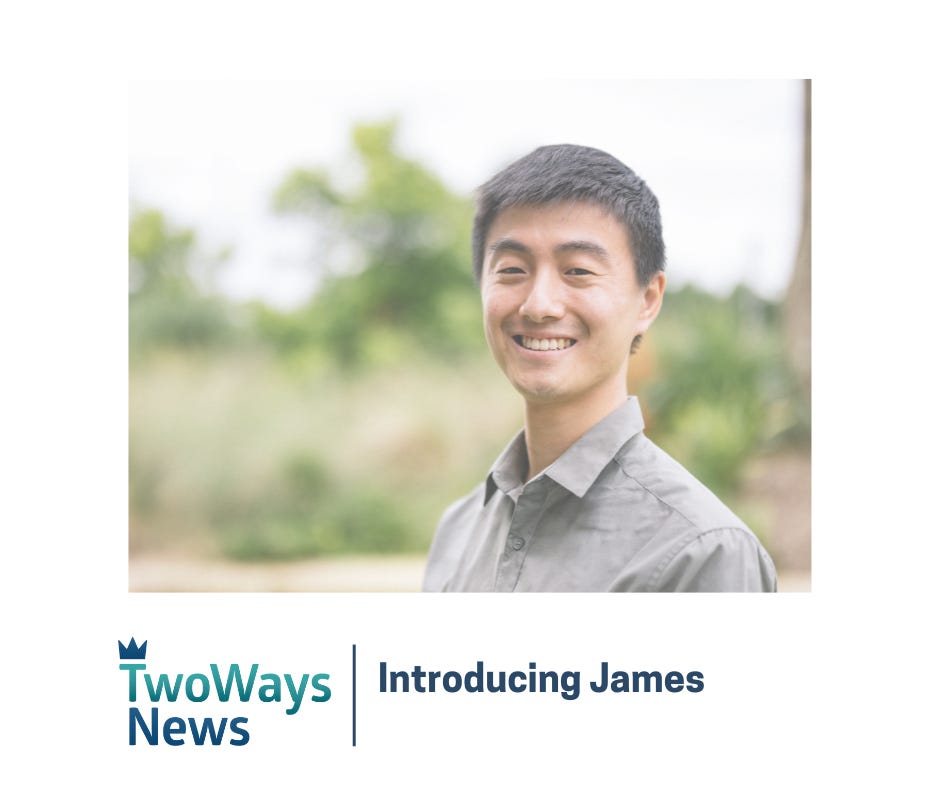
Next year at Two Ways News, we are expanding our regular team of Peter and Phillip Jensen by adding James Chen. James has just finished Moore College and has been ordained to minister at St Andrew’s and St Paul’s in Wahroonga, and we hope to have him as a regular member of our team. So this episode introduces James to our podcast family with a fascinating description of his life story.
Yours,
Phillip
Phillip Jensen: Friends, before we get to this week’s episode of Two Ways News, can I make a Christmas suggestion to you? How about you give a subscription to Two Ways News as a Christmas present to a friend or to a family member? Click here or go to the foot of the page.
On today’s episode of Two Ways News, I am here not with my brother Peter, but with James Chen. James is about to leave Moore College to go into ministry elsewhere, and will feature on this podcast next year alongside Peter as we continue Two Ways News. Today, we thought we’d take some time to give you the opportunity to get to know our newest team member. So to start off, let’s go back to the beginning. James, where were you born?
James Chen: I was born here in Sydney, but my parents migrated from Shanghai, China, in 1991, two years before I was born.
Phillip: What were the reasons for your family’s migration to Sydney?
James: My father was the last in his family to come here, after his father, his mother and his four siblings, so he decided to start a new life in Australia with his newly wedded wife.
Phillip: Given your parents are both from Shanghai, was Shanghainese the language spoken at home?
James: That’s right. Shanghainese is a dying dialect because many people in Shanghai learn Mandarin at school, which is the language that they speak in their day-to-day lives; although interestingly, there’s been a slight resurgence in Shanghainese among young people.
Phillip: When did English come into your life?
James: English has been in my life since the beginning. My parents would frequently turn on the radio and the television to make sure that I had English around me to learn. My mum would also try to speak to me in English. My family had home videos of her teaching me the alphabet, as well as certain English words such as ‘calendar’ and ‘alarm clock’. So I was speaking English very early on.
Phillip: Being the child of a migrant and learning English alongside maintaining the family language is a typical story for many Australians.
James: Indeed. Growing up, it was very confusing to learn two languages. I would ask myself, “Am I meant to speak to my mother in Chinese or in English?”
Phillip: I presume that when you went to school, you realised that you were surrounded only by English.
James: That’s right. It was strange to grow up in a bilingual home, then to go to preschool and school and realise that only English was spoken, and that most people did not know two languages at home. I went to Croydon Park Public School, and even my Greek friends there didn’t know much Greek other than the Greek alphabet. Another thing that was different about me was that I went to school from Monday to Friday, but then on Saturday, I attended Chinese school to learn Mandarin and simplified Chinese.
Phillip: They wouldn’t have taught Shanghainese there, though.
James: They didn’t. The first time I went back to Shanghai, my relatives and friends all made fun of me for not knowing Shanghainese, which grew my resolve to learn it.
Phillip: Do you have many opportunities to practise it these days?
James: Not particularly. We see my parents every fortnight, and my wife Vivian’s parents every other fortnight. Vivian was born in Hong Kong, and she speaks Cantonese. It’s interesting to tell our friends that our parents, who are both Chinese, don’t have a common dialect. Often, they default to English.
Phillip: Indeed. Many of us Anglo-Australians think all Chinese people speak the same language, but that’s not the case.
So you attended Australian schools. Which area of Sydney did you live in?
James: I grew up in Randwick, moved to Ashfield, went to school in Croydon Park, and then I went to school in Marrickville for Years 5 and 6. In Year 7 I was accepted into James Ruse Agricultural High School in Carlingford.
Phillip: Where in this process did you become a Christian?
James: My parents aren’t Christians; they’re culturally Buddhist. Specifically, they are part of the particular mainland Chinese variety of Buddhism, which has many elements of Taoism and Confucianism mixed into it. But growing up, I had some Christian influences, and so I had a Bible. I knew enough about the Bible, about God, and about Christianity to know that I was a sinner. I don’t think I ever doubted that God existed; what I doubted was where I stood with him, and if he would accept me. Throughout high school, I would attend the Christian group occasionally. James Ruse used to have a very strong Christian group which, at its peak, had about 140 students attending every Friday afternoon at lunchtime to hear a Bible talk.
Phillip: It’s remarkable that there was such a strong Christian group at a non-religious school.
James: That’s right, they were going voluntarily. They weren’t obligated to be there. When I was in Year 11, at the age of 16, I still knew that I was a sinner, but I didn’t know enough about the Bible to know that Jesus is my great saviour. I remember on one occasion, I was in my bedroom, and I opened up my Bible and said, “God, if you’re there, show me something.” I flipped open to the book of Amos, and I said, “God, if you’re there, show me something else,” because I didn’t understand what I was reading. The second time, I opened up to the account of the paralytic in Luke chapter 5.
Here a group of people dig through the roof of a crowded building in which Jesus is preaching, in order to lower their paralysed friend to Jesus. The man arrives in front of Jesus, and everyone expects him to heal the man instantly. But seeing the faith of the man and his friends, he says, “Your sins are forgiven.” That’s Luke 5:20. I remember reading that particular verse.
The passage continues with Luke 5:21
And the scribes and the Pharisees began to question, saying, “Who is this who speaks blasphemies? Who can forgive sins but God alone?”
I could sense that something was going on here. In verse 20, Jesus says, “Your sins are forgiven. In verse 21, the scribes and Pharisees say that only God can do that. I consider that to be my conversion moment. I thought, “Jesus is claiming to have the authority of God to forgive sins. If my great problem is that I’m a great sinner, here is the great saviour. Jesus is his name, and he offers to forgive my sins through faith.” I remember praying at that moment, “God, I trust in Jesus. I receive his forgiveness. Please forgive me.”
Phillip: The power of God’s word is fantastic. It never goes forth without achieving his purposes, as the prophet says.
Where did you go from there? Did you talk to a Christian about it? Were you going to church?
James: I wasn’t allowed to go to church yet. My parents wanted me to wait until I’d finished Years 11 and 12 to make those sorts of choices. I did get more invested in the Christian group at school, but the truth is that when I had newly become a Christian, I started looking for Christian podcasts, and I ended up coming across many podcasts by American Christians, including those by Joyce Meyer, Kenneth Copeland, and Benny Hinn.
Phillip: That’s unfortunate. This content is not a good diet for a new Christian.
James: No, it isn’t. But at that point, I was listening to about 10 to 15 hours a week of Kenneth Copeland, Joyce Meyer, Benny Hinn, and a bit of Joel Osteen.
Phillip: That’s not much of an improvement.
James: No, but that was the diet I had through the rest of year 11 and throughout year 12.
Phillip: Friends, can I encourage you to invite people to join Two Ways News? The alternatives that James grew up with are not what I think anyone should listen to.
How did you get out of that into solid Christian Bible teaching?
James: I intended to get my driver’s licence when I finished Year 12, which would mean I could start driving independently. I intended to go to a church in South Sydney, which is a Pentecostal church that preaches the prosperity gospel. By the time I finished Year 12, I didn’t have enough hours yet for my licence, but I wanted to go to church, so in November of 2010 I attended a local Anglican church named St Paul’s Carlingford.
I ended up staying into the next year when I started university. A ministry apprentice named Craig Reid started meeting up with me to read the Bible, and he was exactly what I needed. When we started reading, I would be spouting all kinds of things that I’d heard, and he would say things like, “That’s very interesting; where did you get that from?” He would let me rebuke myself, because eventually I’d realise, “I don’t know where that’s from in the Bible,” and he would say, “That’s because it’s not in the Bible.” It was lovely to have this man take me under his wing and read the Bible with me. I strongly felt his love and affection, because even when he rebuked me, I felt like he cared.
Phillip: That’s good. We’ll come back to where you went as a Christian, but now we will focus on your life after school. What did you go on to do?
James: I went to the University of Sydney to study information technology, because I wanted to be a video game developer. My long-term goal was to travel around the world to different conventions. But I realised very quickly that while I had a mind for the video game side, the information system side was not something that particularly interested me.
Meanwhile, I was meeting with Craig and reading the Bible. I had also gotten involved in the Christian group at university, the Evangelical Union. My interests were shifting as my worldview and my priorities were changing, because I realised that there are real stakes to the gospel truth. God is real. Jesus is Lord, and he is returning one day; that changed every facet of my life. So towards the end of first year, my plan was to become a teacher. I switched degrees the next year to major in physics and philosophy.
Phillip: Which one did you choose: physics or philosophy?
James: I studied physics, chemistry, mathematics, and philosophy, but philosophy ended up taking a lot more of my attention as it piqued my interest. I realised that this was what I wanted to do. I wanted to read more. I wanted to think deeply about our world because it helped me to read the Bible better, to teach the Bible more clearly, and to speak to my friends about Christianity.
In 2012, when I was in second year, the new atheists were still around: Sam Harris, Daniel Dennett, Richard Dawkins, and Christopher Hitchens. The discussions about science and philosophy, about atheism and how that works with religion, were rife amongst my friends and family. Studying philosophy assisted me as I sought to speak with non-Christians about Christianity and to encourage my Christian friends about struggles that they were having. Eventually I switched my physics major to major in the history and philosophy of science at Sydney University.
Phillip: What did you do after university?
James: Throughout high school, I had been working as a tutor at a tutoring college, and after I finished, my plan was either to go directly into ministry training or to pursue postgraduate study in philosophy. But my boss at the tutoring college allowed me to work full-time for a few years, so I became a full-time tutor.
Phillip: Meanwhile, did you stay at St Paul’s Carlingford Church?
James: That’s right. I was involved in children’s ministry, which I loved. This year, one of my first kindergarten children’s ministry girls graduated high school, which I can hardly believe, but that’s part of the joy and the sadness of seeing all these kids grow up.
Phillip: Will she come to Launch Camp for school leavers?
James: I hope so.
Phillip: If you don’t know what Launch Camp is, you can go to phillipjensen.com to find out about it, so that you can pray and encourage others to attend it.
It is exciting doing work with children and seeing them grow. What other things did you do?
James: I did children’s work, and then I began coordinating a church youth group. I was also doing a lot of itinerant preaching, particularly among the Chinese churches in Sydney. On top of that, I was involved in the Church Missionary Society Summer School, in the Year 9 and 10 kids’ programme. I didn’t grow up with Christian parents, so to have all these people come along who have Christian parents, and to see the difference that makes, was delightful. Some kids came along and were quite hardened to the gospel, but they had a vocabulary that meant that I was able to have discussions with them, and to push them in different ways with a base level of understanding that others just don’t have.
Phillip: It is extraordinarily different. It becomes something of a subculture within our society to be raised in that Christian family bubble. But it does change worldviews. It’s a different understanding of everything around you. On that note, when did you decide to come to Moore College?
James: While I was teaching at this tutoring college, I was dating a wonderful woman, Vivian, and we had discussions throughout that relationship that we would love to put ourselves forward to be trained for a lifetime of service. We were willing to do that vocationally full-time if God would have us do that. But at the very least, we didn’t want to be careerists about it. We told ourselves that we would put ourselves through training and submit to those who would be training us, and they would let us know if we were suitable. But the goal was to go to Moore College, to be trained and to serve for the rest of our lives in whatever situation we may find ourselves in. So after two and a half years of me working at that tutoring college, we began ministry apprenticeships. My wife started a ministry apprenticeship at the Evangelical Christian Union at the Cumberland campus, which was the health science campus of the University of Sydney.
Phillip: It was a great health science campus. There were a lot of Christians there under a great training programme.
James: It was a wonderful ministry, and my wife Vivian, as a student going through the health science campus, had benefited from the ministry of men and women there. So it was only natural for her to want to go back. I began a split apprenticeship where I was doing four days a week with St Paul’s Carlingford and two days a week with Vivian at the University of Sydney Cumberland campus.
Phillip: Did you both come to Moore College, or did babies enter in to disturb this programme?
James: They happened simultaneously. In 2022, when I began my first year of college full-time, Vivian had already been attending part-time the year before. Throughout that year, she was also pregnant, so during my first year of college, our first son Henry was born. That was a whirlwind way to start college.
Phillip: He’s not a passive little boy; he’s very active and very lovely.
So after four years, you’re almost done with college. Can you sum up the Moore College experience?
James: It’s an incredible college, not just because of the faculty, but because of the experience of the cohorts. Knowing that you’ve got the same 20 to 60 people side-by-side with you is a blessing. Being able to learn from each other, teaching each other, blessing and being blessed by each other, being able to talk about what we’re learning, sharing, debating and discussing, and seeing each other’s life in progress throughout the years, is wonderful.
Phillip: Indeed. Our modern tertiary education is nothing like that. You go there, you come home; your life is not there, you don’t know anyone other than the lecturers, and you may not get to meet anybody who’s in the same course. So the old ideal of university, of students living together and learning with each other, is almost totally gone from many universities, especially with the prevalence of online courses. It’s very impersonal. The Moore College experience of residential learning with the same group is completely different.
James: It’s fantastic. To be able to disagree with someone who you’ve known as a brother or sister in Christ for the last few years, and to see how you grow together, is a privilege we have as students at Moore College. You can have a level of conversation, of disagreement, and of sharpening one another that you can’t afford when you don’t have that kind of relationship. It’s especially difficult to form a relationship of that sort when you don’t know who might be in your next class.
Phillip: Likewise, the lecturers are different in their relationship with you.
James: Indeed. It’s interesting because these faculty members could have incredible careers in the world of academia, writing, speaking and touring, but they are first and foremost pastors. Therefore, they do a lot of pastoral work with our students: in chaplaincy groups, going on mission each year, meeting up with us throughout the semesters, and teaching. They do important academic work, of course, but the fact that they spend time with us, the accessibility, and the ability to reach out and ask to have a discussion, are all incredible. It’s a wonderful group of people that we get to interact with.
Phillip: Absolutely. If we can focus on the academic side for a moment, what are the key things that you’ve learned?
James: There are so many answers I could give to this kind of question, but one that I love sharing with people is something I learned in second year. We were learning about the doctrine of creation, and as someone who’s read philosophy and about creation ex nihilo, I foolishly went into the unit thinking that I knew what to expect. But I was thoroughly humbled; it was one of the most impactful units I’ve done at college.
One example of how that was the case was when I learned about the contingency of creation; in other words, that creation wasn’t necessary. God wasn’t bound by the need to create. It wasn’t as if there was something missing in him and who he is that meant he needed to create people to satisfy some lack in himself. It’s a profound point, but the thing that particularly struck me was this truth that creation is utterly unnecessary, and therefore it amplifies the love of God. Because on a human level, sometimes love is reciprocal. We think, ‘I love you because of what you can give me,’ or ‘I give you something because of what I can get back.’ But God didn’t need anything from us. God is not missing something, yet he created us and he loves us. He did not have to do that. There is a purity and a complete selflessness to his love that is unmatched by anything else that we can see here in our world.
Phillip: It’s a great thought. Will that improve you as a preacher in the parish church next year?
James: I think so, because a number of the things that you learn at college, if you’ve had a good formation beforehand, give you the guardrails. These truths teach you what not to say. For example, this year in our unit on atonement, we learned about the distortions that some people teach regarding what happened on the cross, particularly around Easter. For example, people talk about the Trinity being disrupted and broken, which is untruthful. What you learn at college is a vocabulary, as well as the biblical grounding, to tell people what the Bible is saying and to not go further, because God’s word is sufficient. We like to over-explain things; we like things to be very neat. But something like that truth, that God didn’t need us and yet he loves us, helps me when I’m talking about why God created.
It’s not as though God needs you to love him, that God is egotistical and selfish. That sort of language is not the biblical picture. Moore College gives us the biblical basis for things and the guardrails to make sure that when we’re teaching, we are seeking to be faithful. But it also teaches us a framework. It teaches us how to find out things. When someone asks me a question, I have tools that college has given me through the languages of the Bible, through church history, through knowing how to discern what’s going on in a commentary, and what assumptions they have that I didn’t have before college. They’ve given me a methodology to approach anything that might come up for the next few decades of ministry, God willing.
Phillip: That’s right. College taught me and gave me the technology to read the Bible. The rest of my life has been spent reading it, but I’ve read it now with the skills and techniques that come from a proper theological education. I’ve looked at some of my old sermons recently, and I can see my progress. When I came out of college, I didn’t know everything, but I knew how to find out everything. So you just keep working. Now, you’re leaving college. Where are you going next?
James: Next year I’ll be headed to Wahroonga Anglican Church, which is in the north shore of Sydney. I will pastor a 9.30am congregation and a 6pm congregation, and help the parish think about and be trained for service. But that’s just what it is in terms of the details and specifics. The big picture of what I’m doing is people, proclamation, prayer, and partnership for the promotion of God’s glory.
Phillip: So James is going to Wahroonga next year, but he is coming back into college for one day a week. That means we can pick up with him in the coming year, so there will be three of us speaking on Two Ways News. As James comes in from time to time, we’ll be exploring other parts of the Scriptures.
We’ve got a special summer programme coming up where Peter and I will go through the great address of Paul on the Areopagus in Acts 17. After that, we’re thinking of picking up one of the longer epistles of the Apostle Paul. But we’ll wait and see what happens as to how James and Peter share with me in looking at the world through the eyes of the Bible next year.
Scripture quotations are from The ESV® Bible (The Holy Bible, English Standard Version®), copyright © 2001 by Crossway, a publishing ministry of Good News Publishers. Used by permission. All rights reserved.
🎁 Support us by giving a Gift Subscription
If you enjoy Two Ways News, why not lend us a hand? Consider gifting someone you know a subscription to our Supporters Club—friends who make it possible for us to keep producing this article/podcast.
To gift a subscription to the Supporters Club, follow the link below to the ‘subscribe’ page. You’ll see that there’s:
a number of ‘paid options’. To join the Supporters Club take out one of the paid ‘subscription plans’ and know we are deeply grateful for your support!
a Gift option
also the free option (on the far right hand side)